


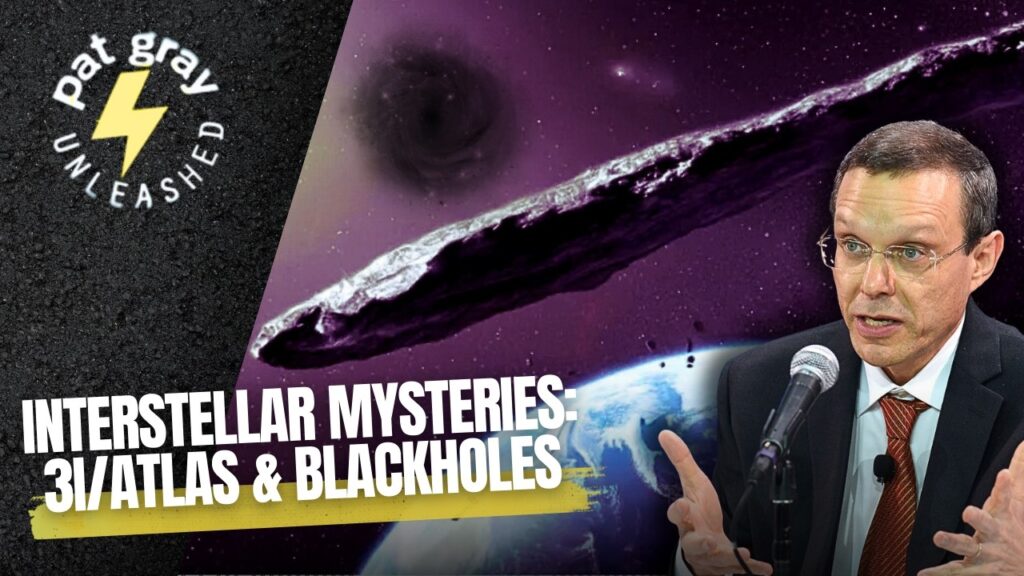
Avi Loeb on Massive Black Holes and the Future of ATLAS explodes with terse, furious urgency about the stubborn mysteries tearing up the sky. He, a Harvard professor, rips into complacent thinking while explaining the nature and significance of supermassive black holes within the Milky Way and across the cosmos.
He also delivers a blunt update on 3I/ATLAS, the mysterious interstellar object now skirting Jupiter, and names the specific observations scientists must demand in the coming months. The interview with BlazeTV host Pat Gray frames the astrophysical stakes, the possible implications for alien-life hypotheses, and the concrete signs people should watch for.

Avi Loeb: background and perspectives
Academic and professional biography including Harvard affiliation and research areas
He has spent his career at the edges where math meets speculation, and he did so wearing the badge of Harvard with a stubborn pride. Avi Loeb is a professor of science affiliated with Harvard University who has led and helped build theory groups and initiatives that bridge astrophysics, cosmology, and speculative inquiry. His CV reads like the sort of academic scaffolding people rely on to give weight to ideas: positions in theoretical astrophysics, leadership roles in institute-level efforts to study compact objects and black holes, and a long record of mentoring students and postdocs. He works on topics that range from the first stars and galaxies to the dynamics of compact objects and the broad theoretical underpinnings of cosmology. He treats big problems — the origin of structure, the physics of black holes, the search for signatures beyond conventional expectations — as if they were personal debts to be paid by rigorous calculation and public argument.
Major contributions to astrophysics and cosmology
He has made substantive contributions to theoretical astrophysics: models of early star formation, studies of the intergalactic medium, calculations on the assembly of structures in the young universe, and a steady stream of papers on compact-object phenomena. He has pushed ideas about how nascent black holes can form and how gas dynamics and radiative processes unfold in extreme environments. Those contributions are not trivial and have influenced colleagues who model cosmic dawn and the growth of structure. He is, however, equally known for the questions he refuses to let die — questions that some colleagues find audacious and others find aggravating.
Public-facing role: outreach, books, and media appearances
He did not confine himself to the academy; he wrote books, took to mainstream media, and cultivated an unmistakable public persona. His book and op-eds, and his frequent appearances on TV and podcasts, are part of a deliberate project to insist that extraordinary claims should be discussed openly and without gatekeeping. That public-facing work has made him a lightning rod: lauded by readers who crave big-picture thinking, criticized by skeptics who see overreach. He speaks in plain, impatient sentences for audiences who want answers now, and he courts controversy as if it were a legitimate research method. He is a public scientist who courts publicity, and he knows full well that publicity amplifies both insight and error.
Known positions on extraterrestrial life and technosignatures
He is unashamedly provocative about extraterrestrial life and technosignatures, arguing that the search for artificial artifacts and technological traces is not a fringe hobby but a necessary branch of empirical inquiry. He famously argued that at least some anomalous interstellar objects deserve consideration as possible engineered artifacts — an assertion that set off a storm of skepticism and debate. He insists that science must follow the data, not prejudice, and therefore posits hypotheses others find discomforting: that non-natural explanations should be on the table when the natural explanations strain credibility. He is passionate to the point of impatience, and that impatience can sound like certainty to an audience primed for drama.
How his perspective influences interpretation of unusual astronomical objects
He approaches anomalous observations with a stubborn willingness to leap to bold hypotheses, and that posture skews interpretation in predictable ways. Where caution would urge cataloging uncertainties and listing conservative models, he will often foreground the extraordinary possibilities — engineered probes, technosignatures, or unconventional physics — as viable working hypotheses to test. That stance has value: it forces the community to examine assumptions and to gather targeted data. But it also invites sensational headlines and public misunderstanding, because bold hypotheses are easier to digest than slow, painstaking data-gathering. His perspective thus acts like a magnet: it draws attention and resources but also distorts how the public and some journalists frame probabilistic claims.
Context of the BlazeTV interview
Participants and format: Avi Loeb, host Pat Gray, and the BlazeTV audience
He appeared on a BlazeTV segment with host Pat Gray in a format designed to provoke and amplify: a single-expert interview aimed at a large, ideologically varied audience. Pat Gray steered the conversation in the style of popular cable interviews — conversational, leading at times, and calibrated for engagement rather than technical nuance. The audience was the typical BlazeTV mix: viewers hungry for clear, bold statements and little appetite for caveats. The live or recorded format compressed complex scientific arguments into short soundbites, and that compression favored Loeb’s knack for memorable phrasing.
Main topics covered in the conversation
They covered the nature and significance of supermassive black holes within the Milky Way and the broader universe, and pivoted quickly to the much flashier topic that attracts attention: the object labeled 3I/ATLAS and its reported approach near Jupiter. The discussion moved between sober explanations of black hole physics and speculative commentary on the origin and nature of an anomalous interstellar object. He supplied theoretical context, warned of the pitfalls of premature conclusions, and nevertheless allowed himself provocative possibilities — all on a program that rewards the provocative.
Why the interview matters for public understanding of astrophysics
It matters because most of the public does not read technical journals; they hear scientists via media appearances. When a prominent scientist speaks on an accessible platform, their tone, emphasis, and speculative instincts shape what millions believe about the cosmos. The risk is not only error but the subtle flattening of scientific uncertainty into theatrical certainty. The interview mattered because it illustrated how complex topics — black hole demographics, observational limits, the criteria for assessing interstellar objects — can be simplified into narratives that entertain rather than educate. Given Loeb’s influence, that simplification can skew public funding priorities and the cultural sense of what is scientifically credible.
How media framing can affect scientific nuance and public reaction
They framed nuance into headlines and bite-sized claims, and in doing so they courted misunderstanding. Media framing reduces probability distributions into punchlines: “alien probe?” reads easier than “unknown object with interesting properties but unconstrained non-gravitational accelerations and limited spectral data.” When a media outlet favors drama, it amplifies the extraordinary interpretation and muffles caution. The consequence is a public reaction that oscillates between euphoric belief and dismissive ridicule, neither of which helps the slow, methodical work of collecting spectra, refining orbits, and excluding mundane explanations. Media framing can therefore turn a measured scientific process into a popularity contest, with the loudest narrative winning attention rather than the most probable explanation winning endorsement.
Fundamentals of massive black holes
Definition and mass ranges distinguishing stellar, intermediate, and supermassive black holes
They must be defined by mass and origin: stellar black holes arise from the collapse of massive stars and typically weigh on the order of a few to a few dozen times the mass of the Sun. Intermediate-mass black holes, if they exist in abundance, sit in the murky gulf between roughly a hundred and a few hundred thousand solar masses — a category that remains observationally murky and fiercely debated. Supermassive black holes are the beasts at galaxy centers, ranging from hundreds of thousands to tens of billions of solar masses. The labels matter because formation pathways, observational signatures, and cosmological roles all depend on which part of that mass spectrum a black hole occupies.
Key physical concepts: event horizon, singularity, and Schwarzschild radius
They orbit around a few core ideas of general relativity. The event horizon is the notional boundary beyond which nothing — not light, not information — escapes to the outside universe; it is a mathematical demarcation with brutal physical consequences. The singularity is the theoretical heart of the black hole where classical physics predicts infinite curvature; many physicists treat it as a sign that new physics is required. The Schwarzschild radius is the simple geometric scale: the radius at which an object of a given mass would become a black hole. Those concepts are not metaphors but rigorous terms that constrain models and observations, and yet they are often flattened into mysticism in popular accounts.
Observable signatures: accretion disks, relativistic jets, and high-energy emission
They do not announce themselves directly; black holes reveal their presence by how matter around them behaves. Accretion disks shine brilliantly when gas heats and radiates as it spirals inward; the spectrum of that radiation—optical to X-ray—yields clues about accretion rate and geometry. Relativistic jets launched from near the black hole can beam energy across intergalactic distances and show up in radio and gamma rays. High-energy emission — X-rays and sometimes gamma rays — betrays hot inner flows and transient flares. Observers infer mass and spin and sometimes environmental conditions from these signatures, not from the dark object itself.
Importance of environment: gas supply, host galaxy nucleus, and dynamical interactions
They must remember context: a black hole’s observable life depends on its surroundings. A black hole in a gas-rich nucleus feasts and shines as an active galactic nucleus; the same mass in a gas-poor environment lurks in darkness. Interactions with stars, dense molecular clouds, and companion black holes alter accretion rates and drive eruptions. Dynamical interactions — mergers, tidal stripping, inflows triggered by galaxy collisions — are the mechanisms that feed and grow black holes over cosmic time. Ignoring environment is to ignore the major determinants of black hole behavior.
Supermassive black holes in the Milky Way
Sagittarius A*: mass, distance, and landmark observations
They call the central mass Sagittarius A*, and it sits like a grudging fact at the center of their galaxy: roughly four million times the mass of the Sun, located about eight kiloparsecs — roughly twenty-six thousand light-years — from the solar system. It is not a monster luminous with accretion; it is a quiet giant whose presence has been inferred and measured through the orbits of stars and through faint radio and infrared emission. The precise mass and distance come from decades of painstaking astrometry and spectroscopy, and the result is one of the most robust dynamical inferences in modern astronomy.
Stellar dynamics and orbital measurements that reveal the central mass
They discovered the central mass by watching stars dance in elliptical, Keplerian orbits around an invisible point. Stars like S2 swing perilously close, mapping the gravitational potential with exquisite precision. Instruments on large ground-based telescopes, adaptive optics, and interferometric techniques have traced these orbits for decades, yielding not only the mass estimate but also a laboratory for testing general relativity in a strong-field regime. The work was methodical and slow and required patience; there are no shortcuts to measuring gravity.
Variable emission and flares from the Galactic Center
They see variability — flares in infrared and X-ray bands that flare by factors sometimes of tens for short intervals — indicating sporadic accretion events or magnetically driven reconnection near the event horizon. Those flares are windows into accretion physics at extremely low accretion rates compared with bright quasars. They reveal a chaotic, intermittent feeding process, not a steady banquet, and they remind observers that even a subdued black hole can produce dramatic, short-lived high-energy phenomena.
Influence on surrounding gas, star formation, and nuclear star clusters
They note that Sagittarius A* shapes its neighborhood subtly but meaningfully. The central molecular zone shows signs of heating and turbulence that influence star formation; nuclear star clusters and young stellar populations attest to episodic bursts of activity and complex dynamical histories. While Sgr A* is not currently a dominant quenching agent on galactic scales, its past may include active phases that expelled or heated gas, and that history is readable in the distribution and motion of stars and gas near the center.
Formation and growth theories for supermassive black holes
Seed mechanisms: Population III remnant seeds and massive stellar collapse
They begin with seeds: one set of models posits that the first generation of stars — Population III stars — were massive and, upon death, left black hole remnants of tens to a few hundred solar masses. Those remnants could serve as seeds that grow by accretion and mergers. Other models invoke the collapse of exceptionally massive stars or stellar clusters that produce heavier seeds. The challenge lies in explaining billion-solar-mass black holes at early cosmic times; small seeds must grow extraordinarily fast to match observations.
Direct-collapse black hole scenarios in early gas-rich halos
They also consider direct-collapse scenarios: under special conditions in the early universe, pristine, metal-poor gas in massive halos could avoid fragmentation and collapse directly into a massive black hole of 10^4–10^6 solar masses. Those pathways are appealing because they lessen the required growth factor to reach supermassive scales at high redshift, but they require rare environments: high accretion rates, suppression of star formation, and strong radiation fields that prevent cooling. These models are speculative but plausible and remain active topics of simulation and observation.
Growth by accretion: Eddington limit, super-Eddington accretion, and radiative efficiency
They grow by eating. The Eddington limit sets a nominal luminosity above which radiation pressure opposes gravity, limiting steady spherical accretion. Yet accretion can be anisotropic and clumpy, and short phases of super-Eddington accretion can occur, especially in dense early environments — transient surges that can drastically speed growth. Radiative efficiency, which converts accreted mass into emitted energy, determines how much mass is needed to reach a given luminosity; lower efficiency yields faster mass accumulation. The balance of these processes determines plausible growth tracks across cosmic time.
Hierarchical growth through mergers and cosmological assembly
They cannot ignore mergers: black holes ride galaxy mergers like passengers on colliding cars, eventually sinking to the merged nucleus via dynamical friction and coalescing in violent gravitational wave events. In a universe built hierarchically, black holes assemble both by accretion and by swallowing other black holes. Cosmological assembly models show that a combination of seed mass distribution, accretion history, and merger rate can plausibly produce the observed population of supermassive black holes — but tuning is required, and many uncertainties remain.
Observational techniques and instruments relevant to black holes
Radio interferometry and very long baseline observations (e.g., EHT)
They use radio interferometry with arrays spread across continents to achieve microarcsecond resolution: the Event Horizon Telescope and similar very long baseline interferometers can resolve structures on the scale of the event horizon in nearby supermassive black holes. Those techniques convert time and baseline into resolving power, allowing observers to image shadow-like features, probe jet bases, and constrain black hole spin and orientation. The technical achievement is enormous, and the data require painstaking calibration and modeling.
X-ray and gamma-ray diagnostics of accretion and jets
They rely on X-ray telescopes to probe the inner accretion flow where temperatures reach millions of degrees, producing X-ray signatures from hot coronae, reflections off inner disks, and transient flares from tidal disruptions. Gamma-ray instruments reveal relativistic jet emission and extreme particle acceleration. Spectral, timing, and polarization diagnostics in these bands are essential to infer inner-disk geometry and energetic processes.
Infrared and optical monitoring of stellar orbits and variability
They track stars at high angular resolution in the infrared and optical, using adaptive optics and interferometry to chart stellar orbits and variability near galactic centers. Long-baseline observations map orbital elements, measure relativistic precession, and yield dynamical mass estimates. Optical and IR surveys also monitor variability that can signal accretion changes or transient events.
Gravitational wave detectors for mergers of compact objects
They listen to spacetime. Ground-based detectors (LIGO, Virgo, KAGRA) capture stellar-mass black hole and neutron-star mergers; planned space-based detectors (LISA) will probe the inspiral and merger of massive black holes. Gravitational waves give direct access to dynamics that electromagnetic observations cannot see, and they will redefine understanding of black hole demographics and growth pathways.
Time-domain surveys and automated sky monitors such as ATLAS
They monitor the sky relentlessly for transients. Time-domain surveys like ATLAS, ZTF, and the forthcoming Vera Rubin Observatory scan wide areas repeatedly to catch moving objects, supernovae, tidal disruption events, and other transient phenomena. Automated monitors provide the early warnings and discovery streams that trigger targeted follow-up across the electromagnetic spectrum.
Physical processes in the vicinity of black holes
Accretion disk structure, viscosity, and thermal states
They model disks as complex, multi-state systems: thin, radiatively efficient Shakura-Sunyaev disks operate at high accretion rates, while radiatively inefficient accretion flows (RIAFs) occur at low rates and produce different spectra. Viscosity — parameterized by alpha in many models — governs angular momentum transport and thus accretion rate. Thermal states transition, changing emissivity and geometry, and those transitions produce observable spectral and timing signatures.
Magnetohydrodynamic processes and jet launching mechanisms
They accept that magnetic fields are not optional details but central actors. Magnetohydrodynamic turbulence transports angular momentum; ordered poloidal fields tapping black hole spin (Blandford–Znajek mechanism) or disk rotation (Blandford–Payne) can launch relativistic jets. The detailed interplay of field topology, accretion rate, and black hole spin sets jet power and collimation, and MHD simulations are the primary tool for exploring those regimes.
Tidal disruption events and transient high-energy phenomena
They record violent flares when a star wanders too close and is ripped apart — tidal disruption events — producing luminous, multiwavelength transients that probe the sudden onset of accretion. Those events illuminate the feeding of dormant black holes and provide laboratories for disk formation and jet onset under extreme, time-dependent conditions.
Relativistic effects useful for testing general relativity near horizons
They exploit relativistic signatures — gravitational redshift, light bending, frame dragging, orbital precession — to test gravity in regimes where deviations from general relativity, if present, might become visible. Observations of stellar orbits, spectroscopic line shapes, shadow-like images, and pulsar timing near black holes can constrain alternative theories. These tests are hard, slow, and exacting, and they demand rigorous control of systematic uncertainties.
Black holes and galaxy evolution
Feedback processes: AGN-driven winds, jets, and their impact on star formation
They acknowledge that black holes do not live in isolation; they affect their hosts. Active galactic nuclei can drive winds and jets that heat and expel gas, throttling star formation in the host galaxy. Feedback processes can be both constructive and destructive: they can compress gas and trigger local bursts or sweep away fuel and quench star formation on larger scales. Modeling the multiphase interstellar medium’s response to AGN feedback is messy and crucial.
Empirical correlations such as the M-sigma relation and their interpretations
They point to empirical correlations — notably the M-sigma relation linking black hole mass and the velocity dispersion of the host bulge — as evidence of coevolution. The tightness of these correlations suggests feedback or coupled growth mechanisms, though causality is difficult to infer. Interpretations range from self-regulated growth through AGN feedback to statistical outcomes of hierarchical assembly; the truth may be a mix.
Role of black holes in quenching, morphological transformation, and halo gas heating
They frame black holes as potential agents of galactic metamorphosis: AGN outflows can heat halo gas, preventing cooling and star formation, thus contributing to the transformation from blue, star-forming disks to red, quiescent ellipticals. The effectiveness of black hole-driven quenching varies with mass, environment, and epoch, and isolating these effects observationally is an ongoing challenge.
Simulations and observational programs that link black hole growth to galaxy assembly
They run simulations — cosmological hydrodynamic suites like Illustris, EAGLE, and others — and compare them to multiwavelength surveys to trace the coevolution of black holes and galaxies. These programs parameterize feedback and accretion prescriptions and then confront predictions with statistical samples of galaxies and AGN. The result is a dialectic: simulations guide interpretation, observations constrain parameters, and both evolve iteratively.
The 3I/ATLAS discovery and current status
Overview of ATLAS: purpose, capabilities, and time-domain monitoring approach
They designed ATLAS as an automated sky monitor to give early warning of potentially hazardous asteroids and to provide wide-field, high-cadence time-domain coverage. With modest telescopes and sophisticated software, ATLAS scans the sky repeatedly to detect moving and transient sources, generating alert streams that trigger follow-up observations across the globe. Its strength is breadth and cadence, not depth, making it ideal for initial discovery and for tracking objects with unusual motion.
Description of the object labeled 3I/ATLAS and why it attracted attention
They reported an object labeled 3I/ATLAS that attracted attention because commentators described it as interstellar in origin and because preliminary trajectory fits suggested a high incoming velocity and a hyperbolic orbit. In the fevered context of public attention, anything tagged with an “I” for interstellar becomes a provocation: it raises the prospect of a visitor from outside the solar system and invites immediate speculation about origin and nature. The object’s unusual kinematics and any odd photometric behavior are the reasons practitioners and pundits focused on it.
Reported trajectory, velocity, and the predicted passage near Jupiter
They reported that initial orbit solutions indicated a steep hyperbolic excess velocity and an inbound trajectory that, according to some preliminary calculations, would thread a path close to Jupiter. Such a close approach to Jupiter would complicate the dynamics via gravitational deflection and possibly expose the object to tidal or collisional interactions. These early trajectory reports demand refinement: small observational errors can produce large changes in long-term ephemerides, and the influence of planetary perturbations must be treated carefully.
Current observational dataset: telescopes, wavelengths, and cadence of follow-up
They have, as of the public conversation, assembled follow-up from optical telescopes for astrometry and photometry, some infrared observations to constrain thermal properties, and perhaps radio or spectroscopy proposals to probe composition. The cadence varies: ATLAS provides the initial detection and tracking, while larger facilities are being petitioned for deeper spectra and higher-resolution astrometry. The dataset remains incomplete; spectra with sufficient signal-to-noise are essential to determine whether the object shows cometary activity, thermal emission indicative of exposed volatiles, or refractory spectra that could imply an asteroidal or engineered surface.
Conclusion
Key takeaways about massive black holes and their role in galaxies
They must admit that massive black holes are central players in the cosmic story: they regulate gas, light up as AGN, influence the assembly and fate of galaxies, and serve as laboratories for fundamental physics. Their influence is neither uniformly destructive nor uniformly benevolent; it is conditional on environment and epoch. Understanding black holes requires a synthesis of theory, observation across wavelengths, and patient, often tedious data collection.
Summary assessment of the 3I/ATLAS object and the lines of evidence to pursue
They should approach the 3I/ATLAS object with warranted skepticism and targeted curiosity. The most important next steps are robust astrometry to refine the orbit, high-quality spectroscopy to infer composition and activity, thermal infrared measurements to estimate size and albedo, and time-series photometry to detect rotation or outgassing. Only after exhausting natural explanations — non-gravitational forces from outgassing, misestimated ephemerides, collisional debris, or solar radiation effects — should more exotic hypotheses be entertained. Claims of artificial origin belong at the end of a long chain of exclusions, not at the front of a press release.
Outlook for ATLAS, time-domain discovery, and the empirical path forward
They should celebrate the era of time-domain astronomy: ATLAS and its peers are transforming how they catch and study transient and moving objects. The empirical path forward is clear: more coverage, faster dissemination of calibrated data, and coordinated follow-up across the electromagnetic spectrum and with radar and space-based assets when possible. With better data pipelines and a culture that prizes replication and constraint over breathless conjecture, the field will mature and untangle genuine anomalies from artifacts and wishful thinking.
Final note on the balance between bold hypotheses and rigorous testing
They owe the public both imagination and rigor. Bold hypotheses drive discovery and keep science honest by forcing the collection of discriminating data; yet they anger the community when offered without the corresponding chain of evidence. He — and others like him — has been valuable for insisting that unlikely possibilities be ruled out rather than dismissed. But he also has an obligation: to temper theatrical flair with the patient humility of the laboratory and the observatory. Science advances by imagination disciplined by measurement, not by headlines.
Harvard Professor and astrophysicist Avi Loeb joins BlazeTV Host Pat Gray to discuss the nature of supermassive blackholes and their significance within the Milky Way Galaxy and broader universe. Loeb also gives an update on 3I/ATLAS as he shares his thoughts on the mysterious object along with what he is watching for in the coming months as is passes by Jupiter.
► Watch MORE BlazeTV YouTube Videos: / @blazetv
► Join BlazeTV and Watch LIVE Shows Daily!
► Visit the ‘Blaze News’ Website (No Annoying Ads!):
► Sign-Up for our NEWSLETTER:
Connect with us on Social Media:
/ theblazetv
/ blazemedia
