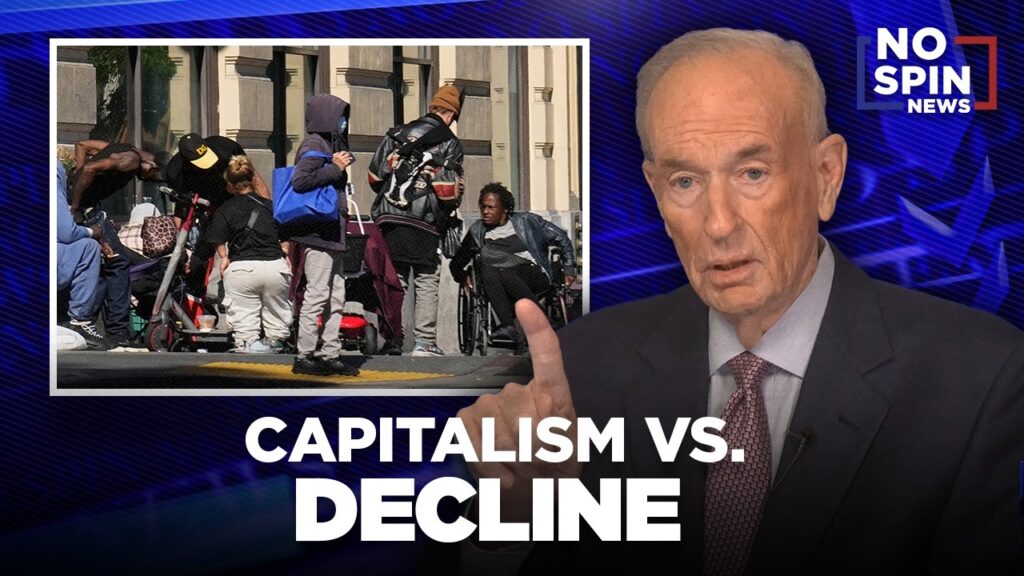
Bill O’Reilly on San Francisco — Capitalism vs. Decline opens with him recapping his Super Bowl weekend and juxtaposing a vivid display of capitalism against signs of urban decline in San Francisco. He situates those observations within broader themes of economic vitality and municipal deterioration, preparing readers for a focused analysis.
The article outlines the video recap, notable on-the-ground observations, and editorial commentary from No Spin News while indicating where full episodes and clips can be found without embedding links. It also highlights the nightly format of O’Reilly’s commentary and the social platforms where viewers may follow the program for ongoing episodes and exclusive clips.

Bill O’Reilly’s Main Thesis
Bill O’Reilly’s central thesis in the segment frames San Francisco as a striking study in contrasts: the spectacle of capitalism, epitomized by Super Bowl weekend, unfolds against a backdrop of urban decline. He argues that the city’s visible social problems—homelessness, public disorder, closed storefronts—are not anomalies but symptomatic of deeper failures in governance and civic stewardship. The segment presents capitalism as a force that generates conspicuous wealth and consumption while also exposing the limits of local institutions to translate that affluence into broad-based urban health.
Summary of the central argument about capitalism and urban decline
O’Reilly contends that capitalism, when operating at its most visible level—corporate sponsorships, luxury hospitality, and consumer excess—creates a dramatic public-facing prosperity that can coexist uneasily with urban decay. He suggests that if a city cannot manage basic public order and infrastructure while hosting a national entertainment event, then the prosperity on display is superficial. The argument posits a causal relationship whereby policy choices, regulatory environments, and civic neglect allow market energy to become detached from everyday civic wellbeing.
How the Super Bowl weekend serves as a narrative anchor
Super Bowl weekend functions in the segment as both a magnifying glass and a stage. It magnifies disparities by bringing thousands of visitors into neighborhoods where poverty and neglect are conspicuous, and it stages capitalism in its most theatrical form—branding, VIP experiences, and concentrated consumer spending. O’Reilly uses the event as a temporal anchor to demonstrate how a city presents itself to a national audience and to argue that the dissonance between spectacle and street-level reality is telling about priorities and leadership.
Tone and rhetorical approach used by O’Reilly
The tone in the segment is assertive and direct, employing rhetorical contrast to heighten impact: images of affluence juxtaposed with depictions of squalor, measured commentary followed by pointed criticism. O’Reilly uses anecdotal evidence and strong language to convey urgency and moral judgment, appealing to viewers’ emotions as well as their sense of civic expectation. The style aims to persuade by creating a clear villain—failed local governance—and a visible problem that demands accountability.
Intended audience and persuasive objectives
The intended audience appears to be a national, politically attentive viewership that favors market-oriented solutions and robust public order. O’Reilly seeks to persuade skeptics and moderates that urban decline is not an abstract policy problem but a visible failure undermining American cities. The objectives include mobilizing opinion against current local leadership, advocating for reforms that prioritize safety and business-friendly policies, and framing the issue as part of a broader national debate about the role of government and market dynamics in urban life.
Contrast Between Capitalism and Urban Decline
O’Reilly’s segment draws a sharp line between the ostentatious manifestations of capitalism and the lived realities of urban decline, presenting the two not as paradoxical but as mutually revealing. Capitalism, in his telling, produces concentrated moments of dazzling consumption that expose the underlying fragility of civic institutions when those institutions cannot harness or channel market benefits into everyday public goods.
Definition of ‘capitalism’ as presented in the segment
Capitalism, in the segment, is presented primarily as the outward show of market success: corporate sponsorships, high-end hospitality, branded events, and spending power visible during Super Bowl weekend. It is depicted as energetic, decentralized, and driven by private actors who create spectacle and revenue. The emphasis is on consumption as a public performance rather than on complex economic mechanisms or distributional outcomes.
Definition of ‘decline’ with reference to San Francisco
Decline is defined through visible indicators: diminished street cleanliness, widespread homelessness, vacant storefronts, and perceived reductions in safety and civic order. O’Reilly treats decline as a decline in municipal competence and public morale—a loss of the basic functions citizens expect from local government. The narrative emphasizes the experiential and aesthetic dimensions of decline, suggesting that these signals reflect deeper systemic problems.
How prosperity and decay are juxtaposed in the narrative
Prosperity and decay are placed side by side to create dissonance: glitzy suites and sponsored events on one hand, tent encampments and shuttered businesses on the other. The segment uses this juxtaposition to argue that prosperity can be selective, benefiting visitors and affluent consumers while leaving long-term residents to contend with the consequences of policy choices. The implicit message is that economic success in headline metrics does not automatically translate into a healthy urban ecosystem.
Underlying assumptions about market forces and civic health
The segment assumes a close relationship between regulatory environments, civic competence, and the ability of market forces to support flourishing cities. It leans on the premise that markets can generate prosperity but require competent governance to ensure that prosperity translates into public goods like safety, sanitation, and functional infrastructure. There is an underlying belief that policy missteps—overregulation, leniency on public order, or punitive tax regimes—can blunt the positive effects of capitalism on urban life.
Super Bowl Weekend as Case Study
O’Reilly uses Super Bowl weekend as a concentrated example to illustrate broader themes about priorities, spectacle, and municipal capacity. The event becomes more than a sports occasion; it is a stress test for infrastructure, a showcase for corporate branding, and a narrative device that highlights contrasts between national attention and local vulnerabilities.
Descriptions of consumer spectacle, corporate sponsorship, and spending
The segment highlights the crescendo of commerce surrounding the Super Bowl: pop-up experiences, branded activations, luxury hotels filled to capacity, and a flow of discretionary spending. O’Reilly emphasizes the visibility of corporate money—logos, stagecraft, and hospitality suites—suggesting that the weekend is an emblem of capitalism at full theatrical scale. The portrayal underscores how transient influxes of wealth and attention can mask persistent, underlying social problems.
Examples of infrastructure strain and public safety concerns during the event
O’Reilly points to strain on transportation, crowd management, and sanitation as immediate consequences of hosting a major event amid urban dysfunction. He cites anecdotes and imagery of overflowing public spaces, police resource allocation challenges, and the difficulty of maintaining public order when basic services are already stretched. These examples are used to argue that the city’s capacity to manage both quotidian needs and extraordinary events has been compromised.
Use of anecdotes and visuals to contrast affluent visitors and local conditions
The segment relies heavily on juxtaposed anecdotes and visuals: VIP areas and celebrity arrivals contrasted with street-level images of homelessness and neglected streets. O’Reilly’s storytelling choices are designed to make the contrast visceral, inviting viewers to see not just statistical decline but human stories—visitors experiencing polished entertainment while residents face daily instability.
What the weekend symbolizes about national priorities and local decline
For O’Reilly, the weekend symbolizes a broader national tension: a culture that celebrates consumption and spectacle at the same time it tolerates or ignores eroding civic conditions. The Super Bowl becomes a metaphor for misplaced priorities—where resources are funneled into elaborate, short-term displays rather than sustained investment in basic municipal functions. The segment frames the event as a mirror reflecting national choices about what is valued and what is neglected.
Economic Indicators and Metrics
While the segment is more visual and anecdotal than data-driven, it gestures toward several economic indicators that viewers might expect to explain or contradict the narrative of decline. O’Reilly implies that metrics such as employment, wages, housing signals, and business activity are relevant to assessing whether visible problems correspond to economic malaise or governance failures.
Employment, wage, and job growth data cited or implied
The commentary implies a disconnect between headline job growth—often reported in tech sectors—and lived economic conditions on the street. O’Reilly suggests that while certain industries may be thriving, that growth has not necessarily translated into broad-based wage gains or stable employment for the city’s most vulnerable residents. The segment leaves these implications largely qualitative, relying on observations rather than a systematic presentation of labor statistics.
Housing market signals including affordability and vacancy
Housing is treated as central to the narrative of decline: high rents, displacement, and the peculiar coexistence of luxury housing with visible homelessness. O’Reilly implies that affordability problems and vacancy patterns—whether empty high-end units or congested shelters—reflect policy failures. The segment does not systematically parse vacancy rates or zoning dynamics but uses housing imagery to underscore contradictions in how market-driven development interacts with social need.
Business openings and closures across neighborhoods
O’Reilly points to boarded or closed storefronts as evidence of a weakening local commercial base, especially in neighborhoods that once depended on steady foot traffic. He contrasts these closures with pockets of vibrant commerce tied to the Super Bowl, suggesting that the health of the city’s small-business ecosystem is uneven and sensitive to perceptions of safety and regulatory burden. The account is anecdotal rather than comprehensive, intended to invite scrutiny of broader economic trends.
Crime statistics and their interpretation in the segment
Crime is invoked as a key indicator of civic decline, with the segment highlighting publicized incidents and perceived increases in disorder. O’Reilly uses selected examples to argue that crime undermines commerce and quality of life. The treatment is interpretive rather than statistical; the segment does not present rigorous crime-rate analyses but rather emphasizes narrative impact, which may align with audience concerns about safety even when the data are more nuanced.
Policy and Governance Critique
A central thrust of the segment is critique of local leadership and policy choices. O’Reilly positions municipal governance as the locus of responsibility for the city’s visible problems, arguing that decisions about regulation, enforcement, and fiscal priorities shape whether market energy contributes to broad-based urban health or to fractured spectacle.
Criticisms of local government decisions and leadership
O’Reilly criticizes elected leaders for what he frames as a lack of urgency and accountability in addressing homelessness, public sanitation, and public safety. He suggests that leadership has tolerated policies and practices that have eroded civic order and that political rhetoric has sometimes eclipsed practical problem-solving. The critique is framed in moral and managerial terms, calling for leaders to demonstrate competence and prioritize constituents’ everyday needs.
Assessment of regulatory and taxation impacts on business
The segment argues that onerous regulation and punitive tax environments can disincentivize small businesses and deter investment in neighborhoods struggling to rebound. O’Reilly contends that policy choices—including permitting bottlenecks and tax structures—have tangible effects on the vitality of streetscapes and commercial corridors, making it harder for entrepreneurs to thrive in the city.
Discussion of law enforcement policy and public order
O’Reilly raises concerns about law enforcement approaches, suggesting that decriminalization or lenient enforcement in certain areas has contributed to visible disorder. He calls for robust policing that balances civil liberties with community safety, implying that inadequate enforcement undermines both residents’ security and the confidence of visitors and investors. The segment does not offer a detailed blueprint for reform but emphasizes the need for clearer accountability and results.
Role of state and federal policy in shaping local outcomes
While the focus is primarily local, O’Reilly acknowledges state and federal roles—such as funding for mental health services, housing subsidies, and intergovernmental coordination—as relevant to city outcomes. He argues that higher levels of government can influence incentives and provide resources, and that a lack of effective partnership can exacerbate municipal challenges. The critique suggests that multi-level governance failures contribute to intractable local problems.
Social Issues Highlighted
The segment foregrounds social issues—homelessness, public health, and community displacement—as visible symptoms of decline. O’Reilly uses human images and stories to evoke moral urgency, portraying these issues as not merely policy abstractions but lived realities that affect residents and visitors alike.
Homelessness and visible poverty as evidence of decline
Homelessness is central to the narrative as a visible, persistent sign of civic struggle. O’Reilly frames tent encampments, panhandling, and street-level suffering as evidence that policy responses have been insufficient. The presentation emphasizes human dignity while also using visibility as a metric of municipal failure, arguing that when poverty becomes a prominent feature of public spaces, it signals systemic neglect.
Public health and sanitation concerns presented
Public health and sanitation—litter, human waste, and neglected public spaces—are presented as immediate, tangible consequences of policy neglect. O’Reilly connects sanitation to perceptions of safety and economic viability, suggesting that cleanliness is not merely cosmetic but foundational to a functioning city. The segment treats sanitation as both a practical concern and a symbol of municipal competence.
Impact on small businesses, residents, and tourism
O’Reilly highlights the ripple effects of visible decline on small businesses, long-term residents, and tourism revenue. He argues that persistent disorder erodes consumer confidence, dissuades foot traffic, and disincentivizes new investment, thereby perpetuating cycles of decline. For residents, the consequence is a diminished quality of life; for tourism, the risk is reputational damage that can have economic consequences beyond a single event.
Cultural and demographic shifts referenced in the commentary
The segment touches on cultural and demographic changes—shifts in neighborhood character, displacement of long-standing communities, and the influx of transient wealth—that shape perceptions of belonging and civic identity. O’Reilly interprets these shifts as part of the broader narrative of dislocation: market forces and policy choices reshape who benefits from urban prosperity and who carries the costs of decline.
Comparisons with Other Cities
O’Reilly situates San Francisco within a comparative urban frame, contrasting it with cities he portrays as having navigated similar challenges more effectively. These comparisons are used to argue that policy choices—rather than inevitable urban fate—determine trajectories of decline or recovery.
San Francisco compared to other major metropolitan areas
The segment contrasts San Francisco with other major cities that have maintained or restored public order and economic vitality. O’Reilly implies that San Francisco’s struggles are not universal and that differences in governance, enforcement, and policy emphasis can lead to divergent outcomes among peer cities. The comparison intends to challenge the notion that San Francisco’s problems are unique or unavoidable.
Examples of cities that recovered through market-oriented reforms
O’Reilly references, in general terms, cities that pursued market-oriented reforms—streamlining regulations, incentivizing business growth, and prioritizing public safety—and that saw tangible recovery. These examples function as models in his argument that policy shifts can facilitate urban revival. The segment emphasizes pragmatic, pro-business interventions as effective tools in reversing decline.
Contrasts with cities highlighted as success stories for governance
Cities lauded for governance success are presented as studies in purposeful leadership: decisive mayors, coordinated agencies, and policies that align public safety with economic development. O’Reilly uses these contrasts to underscore the role of competent administration and to suggest that different governance philosophies yield different urban realities.
Lessons drawn from comparative urban case studies
The segment draws lessons that center on accountability, prioritization of basic services, and creating an environment conducive to commerce and investment. The message is that cities can learn from one another and that deliberate policy choices—not inevitability—shape urban outcomes. The comparative lens is employed to argue for reforms that are practical and evidence-informed, even if the segment does not delve into technical policy specifics.
Media and Narrative Framing
O’Reilly’s segment is as much about storytelling as it is about facts; the choices made in framing, selection, and presentation shape the audience’s understanding of cause and consequence. Media techniques—visual juxtaposition, editing, and selective emphasis—are used to construct a compelling narrative about decline.
How O’Reilly frames San Francisco’s story for impact
O’Reilly frames the story to maximize contrast and clarity: a single symbolic weekend becomes a microcosm of larger municipal failures. He emphasizes human faces and evocative imagery to create empathy while also steering the interpretation toward questions of governance. The framing is designed to resonate with viewers who value order, economic opportunity, and visible accountability.
Selection and omission of facts to shape the narrative
The segment selectively highlights incidents and images that support its thesis while de-emphasizing contextual data—such as longitudinal crime statistics, housing policy complexities, or social service investments—that might complicate the narrative. This selective approach is a common feature of persuasive media: choices about what to include and omit shape the story’s moral and causal conclusions.
Role of visuals, editing, and music in reinforcing themes
Visuals and editing play a central role in reinforcing thematic contrasts: quick cuts between luxury and deprivation, close-ups of human impact, and soundtrack choices that create emotional cadence. These production elements guide the audience’s response, making the contrast feel immediate and morally charged. The segment thereby uses the techniques of storytelling to make a policy argument that is experienced as much as explained.
Potential biases and ideological lenses in the coverage
The coverage bears ideological markers: a skepticism of progressive urban policies, an emphasis on market solutions, and a rhetorical orientation toward accountability and order. These biases are not concealed but function as part of the segment’s persuasive strategy. Viewers should recognize that the piece interprets events through a particular lens—one that privileges certain policy remedies and critiques others.
Public Reaction and Audience Response
The segment’s reception reflects broader political and cultural divides, with reactions falling along predictable ideological lines. Audience response serves as a feedback loop that both validates and amplifies the narrative, shaping ongoing discourse about urban policy and media accountability.
Immediate audience engagement metrics such as views and comments
Immediate engagement for such segments typically includes high view counts, numerous comments, and active social media sharing, especially when the topic intersects with national events like the Super Bowl. Engagement metrics often reflect the piece’s resonance with viewers’ preexisting concerns about urban life and governance, and high interactivity signals that the narrative struck a chord across a range of audiences.
Typical supportive responses and conservative audience perspectives
Supportive responses often emphasize the need for stronger law enforcement, deregulatory measures to spur business, and tougher leadership. Conservative viewers may interpret the segment as validation of critiques about progressive municipal policies and call for practical fixes that prioritize safety and economic opportunity. The segment reinforces policy preferences common in these audiences.
Typical critical responses and progressive rebuttals
Critical responses frequently challenge the segment’s selective framing, arguing that it overlooks systemic causes of homelessness, the role of mental health and addiction, and the contributions of structural inequality. Progressive rebuttals tend to emphasize the need for comprehensive social services, affordable housing, and nuanced governance solutions rather than punitive approaches. Critics may also point out the absence of detailed data and the rhetorical use of isolated anecdotes.
How reactions reflect broader national divides over urban policy
The polarized reactions to the segment mirror larger national debates over the role of government, public safety vs. civil liberties, and market-driven solutions versus social welfare programs. The conversation around San Francisco becomes a proxy for these larger ideological contests, with media narratives both reflecting and shaping partisan divides. The segment thus participates in a national dialogue about urban values and priorities.
Conclusion
O’Reilly’s segment uses the high-profile moment of Super Bowl weekend to argue that capitalism’s spectacle can coexist with, and even illuminate, urban decline. The piece is rhetorically effective in creating clear contrasts and mobilizing concern about governance and civic responsibility, but its reliance on anecdote and selective framing leaves some empirical questions underexamined.
Recap of the central tensions between capitalism and urban decline in O’Reilly’s argument
The core tension presented is between the visible wealth produced by market forces and the persistent, often human, manifestations of municipal failure. O’Reilly argues that when a city cannot maintain basic public goods even as it hosts national spectacles, the gap between market success and civic health becomes starkly apparent—and politically consequential.
Assessment of strengths and weaknesses in the commentary
Strengths of the commentary include vivid storytelling, clear rhetorical framing, and an ability to translate complex urban issues into accessible narrative moments. Weaknesses lie in selective evidence, limited engagement with structural causes, and a tendency to prioritize spectacle over systematic analysis. The segment is persuasive but would benefit from deeper data and a more rounded exploration of policy alternatives.
Broader takeaways for policymakers, citizens, and media consumers
Policymakers should note the power of public perception and the need for visible, effective municipal services to sustain economic vitality. Citizens can use such coverage as a prompt to demand accountability and to seek balanced policy debates that combine compassion with effectiveness. Media consumers should read persuasive segments with an eye toward both rhetoric and data, recognizing what is emphasized and what is left unsaid.
Questions for further analysis and recommended next steps for readers
Further analysis should ask: How do long-term data on employment, housing, and crime align with the visual narrative? What specific policy interventions have empirical support in addressing homelessness and urban safety? How can state, local, and federal actors collaborate more effectively? Readers are encouraged to consult a range of sources, seek out longitudinal studies and municipal data, and engage in local civic processes to inform balanced, evidence-based responses to the challenges highlighted in the segment.
Bill O’Reilly recaps his Super Bowl weekend, breaking down the vivid display of capitalism and San Francisco’s decline.
Subscribe to never miss an episode of No Spin News with Bill O’Reilly: / @billoreilly
Watch full episodes of No Spin News here: • Bill O’Reilly’s No Spin News
Watch clips of No Spin News here: • No Spin News | Clips
Bill O’Reilly’s official YouTube channel – No Spin. Subscribe for No Spin News each night, exclusive clips, and a one-of-a-kind brand of news analysis each night.
Become an O’Reilly Premium Member:
Buy Bill’s New Book Available Now:
Visit Bill’s Website:
Follow Bill on Twitter: / billoreilly
Follow No Spin News on Twitter: / nospinnews
Like Bill on Facebook: / billoreillyofficial