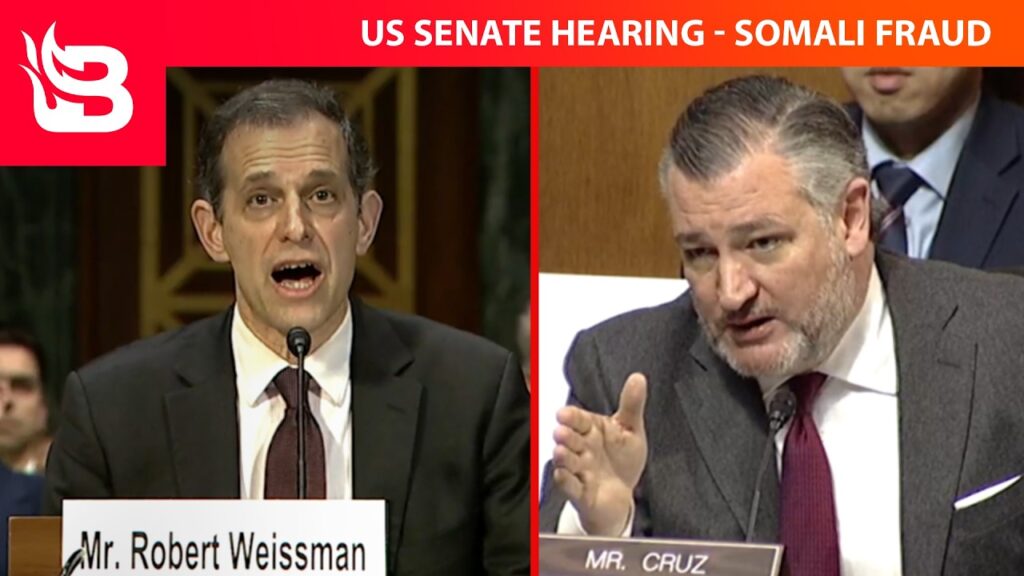
Senator Ted Cruz ignites a tense exchange with Robert Weissman, Co‑President of Public Citizen, over allegations of Somali voter fraud in Minnesota captured on a BlazeTV video; he presses for answers about whether Democratic officials enabled or ignored the misconduct. The confrontation crackles with questions about accountability and the reach of political influence in local elections.
The article outlines claims about the scale of the alleged fraud, the evidence aired during the hearing, and whether figures like Governor Tim Walz could face criminal prosecution. It sketches the legal and political fallout to watch as investigators and courts consider how much officials knew and what, if any, consequences should follow.

Summary of the Confrontation
When the hearing convened, it had the brittle feel of two separate conversations now occupying the same room. On one side stood Senator Ted Cruz, precise and relentless, the cadence of a prosecutor more than a senator; on the other stood Robert Weissman, co‑president of Public Citizen, deliberate and defensive, a man who had built a career on naming institutional failures and drawing careful distinctions. The setting was formal, cameras and microphones capturing every sharp exchange, but the drama lived in the small, human moments: the pause before an answer, the tightening of a jaw, the careful redirection when an assertion outpaced the evidence on the table.
Cruz pressed with questions that suggested a narrative of large‑scale exploitation: that Somali immigrants in Minnesota had been at the center of systemic fraud—voter fraud, welfare fraud, other abuses—allegedly enabled or ignored by Democratic officials in the state. Weissman countered on two fronts. First, he challenged the sufficiency of the evidence as presented in the hearing, insisting that anecdotes and preliminary reports did not amount to a pattern that would warrant the sweeping charges Cruz proposed. Second, he reframed the debate around method and motive, warning that hasty conclusions could stigmatize an immigrant community and that vigorous, impartial investigation was the proper path.
The core questions rippled outward from the exchange: How serious and extensive were the alleged incidents? Did officials, including Governor Tim Walz and other Minnesota Democrats, know about and tolerate misconduct? And if the evidence were solid, who would be criminally accountable? Those questions cut across law, politics, and community relations, and neither Cruz nor Weissman claimed to hold all the answers.
Procedurally, the hearing produced immediate but limited outcomes. There were demands for records and hints that staffers on both sides would follow up. Some Senators signaled interest in subpoena authority for more documents; others urged restraint and more fact‑finding first. No urgent criminal referral emerged directly from the hearing, but the confrontation did accelerate public scrutiny and prompted state and local officials to issue statements clarifying their positions and outlining the status of prior investigations.
Profiles of Key Figures
Ted Cruz: role, responsibilities, and relevance to the issue
Ted Cruz, a U.S. Senator known for his combative floor style and investigative instincts, positioned himself in the hearing as both inquisitor and advocate. He framed his role as protector of electoral integrity and public trust, asserting that inconsistencies and allegations in Minnesota deserved federal attention. His responsibilities on the Senate Judiciary or Rules committees (depending on which panel hosted the exchange) give him a platform to highlight alleged systemic issues and to press for accountability. Cruz’s involvement matters because a senator’s inquiries can catalyze further investigation, shape media narratives, and influence the tenor of partisan debate.
Robert Weissman and Public Citizen: mission and perspective
Robert Weissman leads Public Citizen, a nonprofit focused on consumer rights, corporate accountability, and government transparency. His organization habitually critiques abuses of power and advocates for policy reforms. In the hearing, Weissman’s perspective aligned with caution: he warned against leaping from isolated reports to broad indictments and emphasized the need for rigorous evidence before tarnishing communities or public officials. Public Citizen’s mission colored his testimony—prioritizing systemic analysis and demanding methodical proof over sensational claims.
Tim Walz and Minnesota Democratic leaders: positions and responses
Governor Tim Walz and Minnesota Democratic leaders occupied the noisiest ground outside the hearing room. They were compelled to rebut what they described as exaggerated or inaccurate portrayals of the state’s situation. Their responsibilities encompass ensuring fair elections, credible administration of benefits, and the safety and reputation of Minnesota’s communities, including large Somali populations. Public responses tended to emphasize cooperation with legitimate investigations while rejecting assertions of willful complicity without proof. They framed their actions as responsive to fact‑finding and respectful of due process.
Other witnesses, investigators, and state officials present
The hearing drew a cast beyond the two principals: local election administrators, county prosecutors, investigators from state offices, and sometimes community leaders were either on hand or referenced during testimony. These figures brought procedural knowledge—about how ballots are handled, how welfare audits are conducted, and how allegations are documented. Their presence mattered less for theatrics than for substance: they were the keepers of records and the people who could say whether particular claims tracked with official files. Where they spoke in public, they often emphasized standard investigative practices and the need for evidence to meet prosecutorial thresholds.
Background on the Allegations
Nature of the alleged Somali fraud incidents in Minnesota
The allegations that surfaced encompassed several categories: claims of irregularities in voter rolls and ballot handling, accusations of welfare or benefits fraud, and other assorted assertions of misuse of public resources. Some accounts suggested organized schemes involving multiple actors, while others described isolated incidents or clerical errors mistaken for deliberate deception. Importantly, the allegations were tied to a specific demographic—Somali immigrants—raising questions about whether these were accurate depictions of behavior or narratives amplified by partisan frames.
Timeline of reported incidents and initial investigations
Reports and complaints accumulated over months and years rather than emerging from a single, conclusive revelation. Local news items, police reports, and public statements documented various episodes that critics cited as patterns. In some cases, county auditors or state agencies opened inquiries; in others, reports went to law enforcement and were either pursued or closed. The timeline was messy: allegations were made publicly, some were investigated, some yielded charges, and others did not advance beyond preliminary review. This patchwork chronology made it difficult to draw simple conclusions about scope or intent.
Distinction between types of alleged fraud: voting, welfare, and other claims
A crucial distinction pressed repeatedly during the hearing was between categories of alleged misconduct. Voting fraud typically implicates election law and can draw federal jurisdiction depending on the offense; it requires proof that votes were cast fraudulently or that procedural safeguards were intentionally circumvented. Welfare fraud involves improper claims for public benefits, often requiring financial documentation and audit trails to prove intent to deceive. Other claims—such as misconduct in public contracting or falsified identities—raise different evidentiary and statutory questions. Conflating these categories risks muddling legal standards and inflating perceptions of systemic collusion.
How the allegations entered congressional or media attention
The allegations migrated from local claims into national attention through a knot of media coverage, political advocacy, social media amplification, and investigative queries. Broadcast segments and partisan outlets highlighted sensational elements, while congressional staff scoured public records for patterns. Political actors, seeking narratives advantageous to their constituencies, also played a role: raising the issue at a hearing gave it legitimacy and ensured wider dissemination. Once in that orbit, the story acquired momentum that outpaced some of the on‑the‑ground facts.
Evidence and Testimony Presented
Key evidence cited by Senator Cruz and supporting counsel
Cruz and his staff leaned on a combination of documents, anecdotal testimony, and aggregates of complaints. They cited case files made public by county offices, statistical anomalies in voter registration lists suggested to be implausible, and specific instances where benefit payments appeared irregular. The rhetorical thrust was cumulative: a scatterplot of worrisome indicators that, taken together, suggested systemic problems. Cruz emphasized patterns—similar anomalies across different systems—that he argued made coincidence unlikely.
Arguments and rebuttals offered by Robert Weissman and allies
Weissman offered rebuttals that were procedural and moral. Procedurally, he questioned the provenance and completeness of the documents presented, pointing out omissions and the risk of cherry‑picking. He underscored the difference between suspicion and proof, arguing that flawed methodology or selective sampling could create the illusion of a pattern where none existed. Morally, he cautioned against the political and communal harm of leveling public accusations without full vetting, particularly against minority communities already vulnerable to stereotyping.
Documentary, statistical, and anecdotal materials introduced
The hearing’s evidentiary landscape included spreadsheets, public records requests, excerpts from local prosecutions, and individual testimonies—some from whistleblowers, others from affected residents. Statistical materials sometimes showed spikes or outliers, but those numbers often lacked full context: were the cases authenticated? Were duplicates removed? Did demographic shifts explain statistical oddities? Anecdotes supplied human texture but were insufficient on their own to prove systematic wrongdoing.
Assessment of credibility and gaps in the evidentiary record
Credibility varied across the materials presented. Official documents and prosecutorial records carry conventional weight, but even they require context. Anonymous or secondhand accounts are weaker still. Gaps loomed: missing chain‑of‑custody details for some files, a lack of corroborating witnesses in others, and the absence of comprehensive audits tying disparate claims into a unified picture. Weissman’s central contention—that the evidence did not yet sustain the sweeping claims made—found support in these lacunae, even as others argued that the pattern warranted further inquiry.
Legal Framework and Potential Charges
Relevant Minnesota state criminal statutes and procedures
Minnesota law contains statutes addressing fraud, identity theft, mail and wire fraud analogs, and specific provisions for benefits and election tampering. County attorneys initiate most prosecutions, and statutes define elements that must be proven: false statements, intent to deprive, or unauthorized voting, among others. Procedures include preliminary investigations, grand jury or complaint filings, and the requirement that prosecutors present sufficient probable cause before charging.
Federal statutes that could apply and jurisdictional considerations
Certain offenses—for example, voter fraud affecting federal elections, mail or wire fraud crossing state lines, or conspiracies involving federal benefits—can implicate federal statutes. Federal jurisdiction depends on the nature of the alleged offense and its interstate or federal nexus. The Department of Justice assesses whether federal resources and statutes are appropriate, often deferring to local prosecutors unless the case involves broader civil rights implications or a failure of local enforcement.
Standards of proof required for prosecution in fraud-related cases
Prosecutors operate under two critical standards: probable cause to charge, and proof beyond a reasonable doubt to convict. The former is a threshold judgment often made by a county attorney or federal prosecutor based on available evidence; the latter is a stringent requirement that demands persuasive, corroborated proof at trial. Fraud cases can be challenging because they often hinge on intent, documentary trails, and the credibility of witnesses.
Role of prosecutors and criteria for bringing charges
Prosecutors weigh the strength of evidence, the likelihood of obtaining a conviction, the seriousness of the alleged harm, and resource constraints. They also consider public interest factors and potential prosecutorial discretion. In politically charged contexts, prosecutors face the added burden of defending decisions against accusations of bias—either for bringing charges perceived as politically motivated or for declining to pursue widely publicized allegations.
Investigations and Independent Fact-Checking
Known state and federal investigations into the allegations
Over time, multiple entities—county attorneys, state auditors, and occasionally federal prosecutors—have reviewed complaints originating in Minnesota. Some inquiries have led to charges in isolated cases; others concluded without prosecution, citing insufficient evidence. The pattern was heterogeneous: inquiries varied by county, by the quality of submitted evidence, and by prosecutorial priorities. Where federal involvement occurred, it typically followed referral from local officials or evidence suggesting broader implications.
Findings from independent reporters and fact-checking organizations
Independent journalism and fact‑checking organizations sought to parse the claims, often finding discrepancies between sensationalized accounts and documented cases. Reporters tended to emphasize the number of allegations versus the number of substantiated prosecutions, noting that high headline counts sometimes collapsed under scrutiny. Fact‑checkers stressed that many claims relied on preliminary records, social media posts, or anecdotal reports without full verification.
Discrepancies between public claims and investigative results
A recurring theme was the gap between public statements asserting “rampant” fraud and the narrower findings of investigators. Some high‑profile claims were never matched by commensurate prosecutorial action; other episodes involved local administrative errors rather than criminal schemes. Those discrepancies did not nullify every individual allegation, but they complicated the narrative of systemic, organized wrongdoing.
Recommendations for additional investigative steps
Observers recommended a careful sequence of further steps: comprehensive audits of voter rolls and benefits databases conducted by neutral auditors; cross‑jurisdictional data sharing to identify potential coordinated patterns; witness interviews under oath; and transparent public reporting of methodology and results. Many urged that investigations be insulated from partisan influence to preserve credibility and avoid further stigmatizing communities.
Responses from Minnesota Officials
Statements and actions taken by Governor Tim Walz and office
Governor Tim Walz and his office responded by stressing cooperation with legitimate investigations while rejecting broad accusations of state‑sponsored complicity. Their messaging emphasized rule of law and due process, offering access to state records where appropriate and urging local authorities to pursue credible leads. They sought to balance defending the integrity of Minnesota institutions with openness to uncovering genuine wrongdoing.
Responses from Minnesota Attorney General and county prosecutors
The Minnesota Attorney General’s office and county prosecutors varied in tone depending on the strength of the evidence before them. Some issued statements noting that allegations would be evaluated according to standard prosecutorial criteria; others announced that investigations were ongoing or that prior probes had not found systemic issues. Several district attorneys reiterated their commitment to impartiality and cautioned against overinterpretation of partial records.
Positions of local election officials and welfare administrators
Local election officials highlighted robust procedural safeguards—audits, chain‑of‑custody protocols, and bipartisan oversight—that, they argued, mitigate the risk of large‑scale fraud. Welfare administrators explained that benefits systems include verification steps and that administrative errors can occur without criminal intent. Both groups called for any legitimate concerns to be channeled through proper investigative processes rather than amplified in rhetorical forums.
How state officials addressed or refuted the allegations publicly
State officials combined factual rebuttals—pointing to closed investigations or lack of prosecutable evidence—with appeals to community cohesion. They often framed the public debate as a delicate balance: acknowledging the need to root out fraud where it exists while resisting narratives that could inflame prejudice or undermine trust in democratic institutions.
Role of Nonprofits, Advocacy Groups, and Community Leaders
Public Citizen’s stance and testimony in the hearing
Public Citizen, represented by Robert Weissman, counseled restraint and evidentiary rigor. Its stance was less about defending particular officials and more about protecting procedural integrity and vulnerable communities. In the hearing, Weissman urged the body to prioritize methodical inquiry over political grandstanding and to ensure that advocacy did not eclipse fact‑finding.
Positions of Somali community organizations and leaders
Somali community organizations responded with a mix of concern and insistence on fairness. Leaders worried that allegations would fuel discrimination and erode civic participation among immigrants. At the same time, some community figures asked for transparent investigations to clear any wrongdoing by individuals or groups. Their position often emphasized both accountability and protection against collective blame.
Other advocacy groups that weighed in and their motivations
Various advocacy groups—civil rights organizations, conservative watchdogs, immigrant rights groups—entered the conversation, each with motivations shaped by institutional priorities. Civil rights advocates cautioned against profiling; conservative groups focused on electoral integrity; immigrant service organizations emphasized the human costs of stigmatizing narratives. Each intervention influenced public perception and pressured officials in different directions.
Impact of advocacy on public perception and official responses
Advocacy amplified both urgency and skepticism. Calls for investigation forced officials to respond and clarified where more transparency was needed. Conversely, politicized messaging hardened partisan positions, making compromise and neutral fact‑finding harder. The net effect was to escalate attention while complicating the search for clear, depoliticized answers.
Political Implications and Partisan Dynamics
How the exchange fits into broader partisan narratives about fraud
The confrontation fit neatly into national partisan scripts: Republicans emphasizing fraud and the sanctity of elections; Democrats warning against voter suppression and the harm of misinformation. Each side found in the Minnesota episode material for broader claims about institutional trust and the integrity of democratic processes. The hearing thus served both as local scrutiny and as fodder for national debate.
Potential motivations for political actors to amplify or downplay claims
Political actors may amplify claims to mobilize bases, sow doubt about opponents’ stewardship, or influence upcoming contests. Conversely, downplaying allegations can protect political constituencies, avert panic, or stave off electoral damage. Both strategies are rarely neutral; they reflect calculations about political advantage, risk management, and public image.
Implications for upcoming elections and candidate strategies
Allegations of fraud can reshape electoral strategies—prompting heightened focus on turnout operations, voter education, and legal readiness. Candidates might adjust messaging to reassure skeptical voters or to challenge opponents’ competence. In Minnesota, a battleground with active immigrant communities, such narratives could influence voter mobilization and intergroup relations.
Risk of polarization and effects on governance in Minnesota
The episode risked deepening polarization by importing national animosities into local governance. Heightened mistrust could impair routine collaboration between state and federal authorities, complicate prosecutorial discretion, and chill community participation in civic life. Governance depends on shared rule‑based norms; when those are contested through partisan spectacle, the machinery of oversight becomes less effective.
Conclusion
Summary of major themes from the confrontation and investigation
The confrontation between Ted Cruz and Robert Weissman distilled three recurring themes: the tension between urgent public accountability and careful evidentiary work; the danger of conflating disparate incidents into a single narrative; and the human cost when communities become shorthand in political battles. The hearing underscored that allegations—no matter how loudly proclaimed—must be evaluated by neutral procedures before they translate into charges or policy.
Implications for Minnesota governance, the Somali community, and national discourse
For Minnesota governance, the episode demanded better mechanisms for transparent investigations and clearer communication about the status of probes. For the Somali community, the stakes were social trust, civic participation, and protection from stereotyping. Nationally, the debate fed larger conversations about how to balance vigilance against fraud with safeguards for civil rights and immigrant integration.
Immediate next steps for investigators, officials, and community leaders
Immediate steps included compiling and releasing audit methodologies, coordinating cross‑jurisdictional data reviews, and scheduling neutral third‑party audits where credible gaps persisted. Officials were advised to engage community leaders in outreach to prevent alienation, while investigators were urged to prioritize corroboration before broad public pronouncements. Public education about the distinctions among types of alleged fraud would help depoliticize routine administrative errors.
Final reflections on accountability, due process, and the public interest
The episode illustrated how the pursuit of accountability can become a theater if it outpaces evidence, and how due process can be framed as delay when patience is politically inconvenient. True public interest requires both: the rigorous pursuit of wrongdoing when it exists and the protection of reputations and rights when allegations lack proof. The most constructive path forward is often quiet—methodical investigations, transparent reporting, and leaders who resist the siren call of spectacle in favor of the slow work of truth. In that patience lies the fragile hope of restoring trust to institutions and dignity to communities caught in the crossfire.
Senator Ted Cruz clashes with Robert Weissman, Co-President of the left-wing non-profit group ‘Public Citizen,’ over Somali fraud in Minnesota and the complicity of Democrat politicians in the state. Should Tim Walz and others in the state face criminal prosecution, and how much did they know about the rampant fraud that occurred?
► Watch MORE BlazeTV YouTube Videos: / @blazetv
► Join BlazeTV and Watch LIVE Shows Daily!
► Visit the ‘Blaze News’ Website (No Annoying Ads!):
► Sign-Up for our NEWSLETTER:
Connect with us on Social Media:
/ theblazetv
/ blazemedia