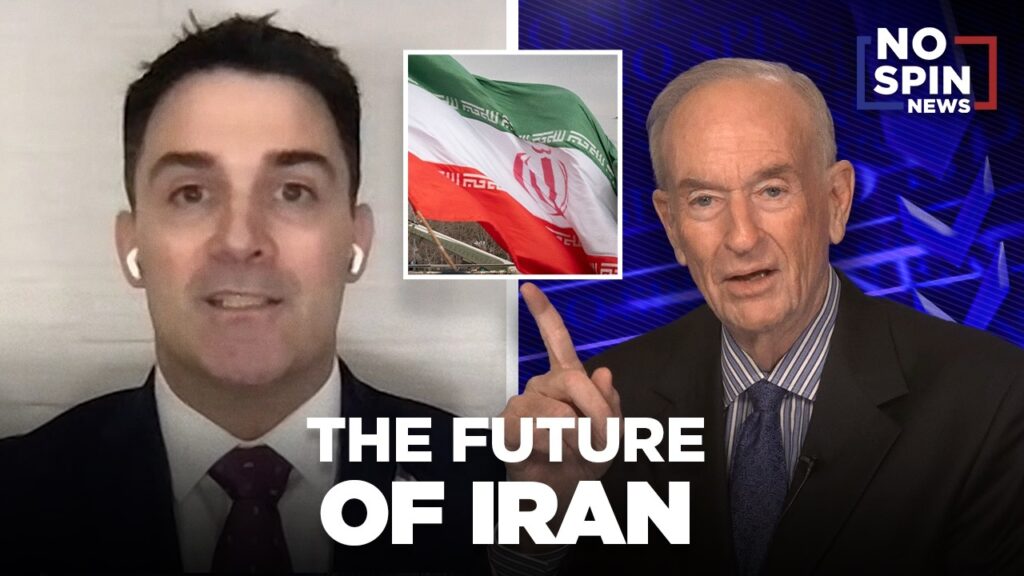
Bill O’Reilly sits at the helm of No Spin News as he engages EJ Kimball in a sharp conversation about Iran’s uncertain horizon. The exchange cuts through headlines to examine Trump’s influence, Tehran’s internal pressures, and the real prospects for regime change.
The piece outlines key arguments on strategic drivers, likely scenarios inside Iran, and the ripple effects for U.S. policy and regional allies. Viewers can expect concise analysis, highlighted clips, and pointers to full episodes that expand on each topic.

Overview of the Conversation
Summary of the No Spin News episode featuring Bill O’Reilly and EJ Kimball
In the small stage of a television set that favors blunt questions and brisk conclusions, Bill O’Reilly invited EJ Kimball to talk about Iran as if the country were a story that could be read in a single sitting. He steered the conversation through familiar beats—Trump-era policies, the possibility of regime change, nuclear anxieties—while Kimball, whose work sits at the intersection of U.S.-Israel relations and policy analysis, answered with a mixture of pragmatism and institutional vocabulary. The exchange threaded current headlines with a larger argument: that Iran’s future is neither inevitable nor easily engineered from outside, and that American and allied choices matter in ways both strategic and moral.
Primary questions raised about the future of Iran
They returned repeatedly to a handful of questions that seemed to sit at the center of both the broadcast’s curiosity and the region’s anxiety: Could internal unrest topple the regime? Would renewed diplomacy slow Iran’s nuclear activities? How effective would a continuation of pressure be, and what would be the cost of miscalculation? Each question carried a subtext—about timing, about the limits of force, and about the human consequences of policy decisions—and the tone often shifted from forensic to speculative as they considered scenarios that ranged from negotiated restraint to violent escalation.
Context of the discussion in relation to recent US and regional developments
The conversation did not happen in a vacuum. It took place against the backdrop of recent shifts: the erosion of the nuclear deal that once constrained Iran’s program, the legacy of a “maximum pressure” campaign, rising proxy tensions across the Levant and the Gulf, and ongoing domestic unrest within Iran. These developments made every assessment feel urgent. The two speakers framed their remarks around how Washington’s posture—diplomacy, sanctions, or force—intersects with regional allies’ strategies and with Tehran’s calculations. The context, therefore, was not only geopolitical but also temporal: a sense that policies chosen now could ripple for years.
Structure and flow of the interview and key moments
The interview unfolded roughly in three acts. First, O’Reilly set the scene with direct questions about Trump’s posture and whether that posture had heightened the chances for regime change. Second, Kimball elaborated on the practical levers available to U.S. policymakers—sanctions, diplomatic channels, and military deterrence—and cautioned against simplistic prescriptions. Finally, the pair examined worst-case outcomes: nuclear breakout, regional war, or chaotic collapse. Key moments came when Kimball pushed back against binary thinking, and when O’Reilly pressed for clearer predictions about timelines. The rhythm alternated between declarative headlines and careful, sometimes somber, appraisal.
Profiles of Participants
Bill O’Reilly background, media platform, and perspective on foreign policy
Bill O’Reilly, long known as a combative commentator with a penchant for plainspoken analysis, hosts No Spin News—a program that frames itself as direct, unvarnished reportage. His rhetorical style privileges clarity and moral simplicity; he often asks whether policies work and whether leaders are willing to accept the costs associated with their choices. On foreign policy, he tends to foreground questions of American strength and deterrence, placing a premium on outcomes that secure U.S. interests and protect allies. In this episode, that posture shaped the conversation’s urgency and its appetite for definitive answers.
EJ Kimball professional role, expertise, and institutional affiliation
EJ Kimball serves as Director of Policy at the U.S. Israel Education Association, a role that situates her at the crossroads of advocacy, analysis, and policy formulation. Her expertise is rooted in the politics of the Middle East and in the practicalities of transatlantic and U.S.-Israel cooperation. She brings to the discussion an institutional memory—the constraints and incentives that shape policymaking—and a sensitivity to how U.S. policy affects allies’ security calculations. Her contributions tended toward measured assessments that weigh leverage against potential fallout.
How their professional lenses shape the analysis offered
Their distinct professional lenses produced a complementary tension. O’Reilly approached the topic as a question of public accountability and decisive action; he sought clear lines from policy to outcome. Kimball, bound to the discipline of policy work, emphasized tradeoffs, unintended consequences, and coalition-building. Where O’Reilly looked for assertive solutions, Kimball underscored complexity and the need for calibrated moves. Together they traced a map of possibilities that was at once direct and hedged with practical caveats.
Notable statements and positions from each participant during the episode
Notable moments included O’Reilly’s insistence on whether Trump-era tactics meaningfully increased the likelihood of regime change, and Kimball’s response that while pressure had eroded Tehran’s capacities and options, it had also hardened its posture. Kimball repeatedly highlighted the role of allied coordination and warned against unilateral measures that could backfire. O’Reilly pushed the conversation into scenarios—would the U.S. consider strikes, or would it rely on sanctions?—inviting Kimball to articulate the spectrum of options and their likely political and humanitarian consequences.
Current Political Landscape in Iran
Formal leadership architecture including Supreme Leader, president, and clerical bodies
Iran’s political architecture is layered and intentionally redundant. At the apex sits the Supreme Leader, who commands the highest religious and political authority and shapes the country’s foreign and security policies. Below him, a president and a cabinet run many day-to-day state functions, but they operate within limits set by clerical oversight bodies such as the Guardian Council and the Assembly of Experts. These institutions intertwine religious legitimacy with state power, creating a system where elected figures govern but unelected clerical authorities arbitrate what is permissible. The result is a concentration of ultimate decision-making in the hands of a narrow elite with clerical credentials and security ties.
Role and influence of the Islamic Revolutionary Guard Corps and security services
The Islamic Revolutionary Guard Corps (IRGC) functions as both a military and political actor; it is a state within a state. It protects the ideological foundations of the revolution, controls significant economic assets, and manages proxy networks across the region. Alongside the IRGC, security services including intelligence organs and volunteer militias such as the Basij enforce internal stability. Their role extends from battlefield operations abroad to crowd control at home. This fusion of military, economic, and political power lends the regime resilience but also creates a regime whose priorities are heavily securitized.
Popular sentiments, demographic pressures, and social grievances
Beneath institutional structures lies a population marked by youthful energy and, often, frustration. Demographics work against the regime in the long term: a young, urbanizing populace with access to global media that chafes at economic stagnation, limits on social freedoms, and pervasive corruption. Social grievances—including unemployment, inflation, and perceptions of elite privilege—have sporadically erupted into protests. Yet these sentiments are not uniform. They range from reformist aspirations to ethno-regional grievances, and from conservative holdouts to those who seek radical change. The complexity of public sentiment resists easy characterization.
Recent political events, protest movements, and elite maneuvering
In recent years, Iran has witnessed waves of protests that have forced elite recalibration. Economic hardship, contested elections, and social restrictions have each sparked unrest. These movements have sometimes been localized, sometimes widespread, and they have been met with a combination of repression and selective concessions. Elite maneuvering—between pragmatic technocrats, hardline clerics, and security actors—has been a constant, with each faction jockeying for influence amid economic pressures and international isolation. Such maneuvering both stabilizes and destabilizes: it preserves the regime while opening fissures that could widen under stress.
Economic Pressures and Sanctions
Overview of the sanctions regime imposed by the United States and partners
Sanctions have been a central instrument of Western policy toward Iran, ranging from targeted asset freezes and travel bans to broad restrictions on oil exports, banking, and trade. The U.S. has often led these measures, sometimes with European or regional partners, aiming to constrain Tehran’s revenue streams and coerce compliance on nuclear and regional behaviors. The architecture of sanctions has shifted over time—tightened under certain administrations, eased or sidestepped under others—but their cumulative effect has been to isolate Iran from large swaths of the global financial system.
Economic effects on Iranian institutions, private sector, and ordinary citizens
The effects of sanctions ripple through every layer of Iranian life. State institutions face budgetary constraints that can hamper public services and defense procurement. The private sector suffers from reduced foreign investment, supply chain disruptions, and currency volatility. Ordinary citizens contend with inflation, unemployment, and diminished access to imported goods and healthcare supplies. Sanctions can create economic hardship that feeds domestic discontent, but they can also strengthen the regime’s bargaining chips by forcing autarkic measures and informal economic linkages that enrich loyalists.
Sanctions effectiveness at achieving political aims and potential unintended consequences
Assessing sanctions’ effectiveness is complicated. They have limited Iran’s ability to freely transact internationally and have signaled international condemnation, yet they have not, on their own, delivered decisive political concessions. Unintended consequences are manifold: sanctions can entrench hardliners who use external pressure to justify repression, funnel resources to shadow economies that empower cronies, and create humanitarian strains that complicate moral claims about policy. In short, sanctions are a blunt instrument—capable of inflicting pain but less adept at shaping nuanced political outcomes.
Sanctions relief as leverage and tradeoffs in policy design
Sanctions relief functions as the flip side of coercion—it is the promised carrot attached to a diplomatic stick. Offering relief can unlock behavior change by restoring economic incentives, but it also carries tradeoffs: relief can be perceived as rewarding bad behavior, it can empower factions within Iran who oppose reforms, and it may have limited impact if funds are diverted to entrenched institutions like the IRGC. Policymakers must weigh how targeted the relief is, how reversible, and how it fits within a broader strategy that includes verification and regional security assurances.
Nuclear Program and Nonproliferation
Current status of Iran’s nuclear capabilities and enrichment activities
Iran’s nuclear activities have evolved over decades, involving research, enrichment, and facilities that complicate inspections. Enrichment levels, stockpile sizes, and the spread of centrifuges are technical indicators that analysts watch closely. While the precise status fluctuates with policy choices and international engagement, Iran retains the scientific capacity and infrastructure to advance enrichment if it chooses to do so. That capacity—combined with opaque decision-making and intermittent cooperation with inspectors—creates persistent international concern.
History and significance of the JCPOA and reasons for its erosion
The Joint Comprehensive Plan of Action (JCPOA) was an agreement that, for a time, placed robust limits on Iran’s nuclear activities in exchange for sanctions relief. Its significance was both technical—reducing enrichment levels and enhancing monitoring—and political—creating a diplomatic channel. The pact eroded after unilateral U.S. withdrawal from the agreement, and subsequent reimposition of sanctions, which fractured the consensus that had supported the deal. Distrust, verification disputes, and domestic politics in Tehran and abroad have all contributed to the agreement’s fragility.
Technical breakout timelines and monitoring challenges
“Breakout time”—the interval required for Iran to produce enough fissile material for a weapon if it chose to do so—has been a recurring metric in policy debates. Estimates vary with assumptions about stockpiles, centrifuge configurations, and clandestine facilities. Monitoring challenges abound: inspectors need clear access, reliable data channels, and the political space to report concerns without obstruction. As Iran advances certain capabilities, the time and certainty around breakout estimations shrink, raising the stakes for diplomatic and technical interventions.
Diplomatic and technical measures to reduce proliferation risks
Diplomacy remains the primary avenue to limit proliferation risks: negotiated limits on enrichment, strict verification protocols, and sunset clauses extended through renewed agreement. Technical measures include improved monitoring technologies, inspections, export controls, and assistance to regional partners for detection and deterrence. Combining diplomatic inducements with robust verification and multilateral buy-in is the most reliable method to manage the nuclear question, though it requires patient, often politically costly, compromise.
Domestic Opposition and Prospects for Regime Change
Spectrum of Iranian opposition groups including reformists, activists, and ethnic movements
Iran’s opposition is not monolithic. It comprises reformist politicians who seek gradual change within the system, activists who push for civil liberties and social reform, and ethnic or regional movements that demand greater autonomy or redress for long-standing grievances. Diaspora opposition groups and exiled political actors add further textures. Each group has different aims, capacities, and constituencies, making the landscape one of fragmented pressures rather than a single unified force for change.
Likelihood that internal unrest could produce rapid regime change versus gradual reform
Rapid regime change from internal unrest is possible but unlikely absent confluence of factors: elite defections, cohesive opposition leadership, and disintegration of security forces’ loyalty. More plausibly, unrest could produce gradual reform, localized concessions, or periodic cycles of repression and renewal. Revolutionary moments are rare and often preceded by cracks in elite cohesion. Analysts caution that predicting a sudden collapse underestimates both the regime’s repressive tools and the inertia of entrenched structures.
Potential for elite splits, defections, or negotiated transitions
The most plausible single shock to the system would be elite splits—when senior officials, military officers, or clerics break ranks. Defections can catalyze broader shifts, especially if they undermine the security apparatus’ cohesion. Negotiated transitions remain possible if factions within the regime seek a managed handoff to avoid collapse or international isolation. Such outcomes depend on bargaining chips, external guarantees, and the willingness of elites to prioritize survival over ideology.
Risks of repression, violence, and cycles of instability
Any movement toward change carries the risk of intensified repression. Security services may respond to unrest with force, creating cycles of violence that deepen societal fractures. Repression can temporarily stabilize the regime but often at the cost of longer-term legitimacy and human suffering. Policymakers and observers must weigh the moral and strategic consequences of supporting opposition movements or of policies that might accelerate instability without offering a credible plan for post-regime governance.
Role of the United States
Legacy of Trump-era maximum pressure and its implications for current policy
The Trump administration’s “maximum pressure” campaign reimposed severe sanctions and sought to choke Iran’s economy to force concessions. Its legacy is mixed: it constrained Tehran’s finances but also hardened Iranian domestic politics and ruptured diplomatic avenues. For current policy, this history complicates trust, as Iranian leaders remain skeptical of U.S. commitments. The residue of maximum pressure informs debates about whether to pursue engagement, maintain pressure, or adopt a hybrid approach.
Policy options available to the US administration and their political constraints
Washington’s options range from renewed diplomacy and sanctions relief to targeted strikes, cyber operations, and expanded sanctions. Each choice is politically constrained: domestic politics shape the appetite for military action; alliances constrain unilateral moves; international law and institutional norms influence diplomatic avenues. Political costs at home—election cycles, public opinion, and partisanship—further limit the scope of sustainable policy. The practical calculus is therefore a negotiation between strategic aims and political feasibility.
Unilateral actions versus multilateral coordination with allies
Unilateral actions can deliver speed and plausible deniability but risk alienating allies and creating regional blowback. Multilateral coordination, while slower and more complex, yields greater legitimacy and shared burden. The choice between them depends on the objective: kinetic, time-sensitive responses may be unilateral; enduring solutions like arms control or sanctions regimes do better with coalition-building. Kimball emphasized the utility of allies in amplifying pressure and in sharing the political and humanitarian burdens of policy.
Domestic political considerations shaping US decisions on Iran
Domestically, decision-makers must navigate partisan divides, public sentiment about military engagement, and the interests of constituencies such as allies and diasporas. Congress holds budgetary power and can sanction or constrain options, while public fatigue with prolonged foreign interventions tempers appetite for new conflict. Electoral considerations can push administrations toward gestures that are politically palatable but strategically short-sighted, creating a tension between immediate political survival and long-term policy efficacy.
Israel’s Interests and Regional Allies
Security priorities and perceived red lines from Israel regarding Iran
Israel’s central security concern is preventing Iran from acquiring a nuclear weapon and disrupting Tehran’s ability to project power through proxies. For Israeli policymakers, red lines include a nuclear breakout and the transfer of advanced weaponry to allied militias. Israel prioritizes deterrence, pre-emption where necessary, and close intelligence cooperation with partners. These imperatives lead Israel to favor firm action when it perceives existential threats, even at the cost of diplomatic friction.
Coordination and occasional divergence between US and Israeli policy
The U.S. and Israel often coordinate on Iran, but not always perfectly. Divergences arise from different threat perceptions, political constraints, and regional responsibilities. The U.S. must balance global legal obligations and the preferences of other allies, while Israel focuses on immediate battlefield superiority and territorial defense. These differences can be managed through consultation, but they can also become sources of tension when one partner pursues a course the other finds risky.
Interests of Gulf Arab states and their incentives for alignment or deconfliction
Gulf Arab states share concerns about Iranian regional influence and have pursued a range of strategies—from overt alignment with U.S. efforts to quiet normalization with Israel and even limited diplomatic engagement with Tehran. Their incentives include securing energy supplies, deterring Iranian proxies, and attracting foreign investment. These states sometimes prefer deconfliction—managing tensions without full confrontation—seeking to avoid instability that would threaten their own regimes and economies.
Proxy networks and how they factor into allied strategies
Iran’s relationships with militias and political movements across Iraq, Syria, Lebanon, and Yemen create a web of influence that complicates allied strategies. These proxy networks serve as both deterrent and leverage for Tehran, enabling asymmetric operations without direct Iranian footprints. Allies therefore calibrate responses—targeting specific proxy capabilities, supporting partner defenses, and using sanctions against networks—while trying to avoid escalation into broader conflict.
Regional Power Dynamics
Russia and China’s strategic relationship with Iran and their regional objectives
Russia and China both see strategic value in maintaining ties with Iran. Russia uses its relationship with Tehran to project power in Syria and to complicate Western influence; China sees Iran as a source of energy and as a strategic partner in its broader Belt and Road ambitions. Their objectives are pragmatically transactional: securing economic and security interests, limiting U.S. dominance, and preserving spheres of influence. Their engagement provides Iran with alternative economic and military partnerships that blunt the impact of Western pressure.
Iranian influence in Iraq, Syria, Lebanon, and Yemen and how it projects power
Iran projects power by cultivating political allies, funding militias, and providing advisory and logistical support across the Levant and the Arabian Peninsula. In Iraq and Lebanon, political parties with ties to Tehran wield influence in formal institutions; in Syria, Iran supports the Assad regime militarily; in Yemen, it backs the Houthi movement. This mosaic of influence secures strategic depth for Tehran and complicates any strategy that seeks to isolate Iran regionally without addressing these networks.
Impact of Iran-related instability on regional trade, energy, and maritime routes
Instability tied to Iran can disrupt trade routes, threaten oil and gas infrastructure, and raise global energy prices. Attacks on shipping in the Gulf or the Red Sea, sabotage of pipelines, or blockages of critical chokepoints like the Strait of Hormuz have ripple effects on international markets and on the economies of neighboring states. Regional instability thus becomes a global economic issue, binding distant consumers to near-term security developments.
Balancing and counterbalancing behavior by neighboring states
Neighboring states respond to Iran’s assertiveness in varied ways—by aligning with external powers, bolstering defense capabilities, or engaging in quiet diplomacy. Some seek to balance Tehran directly through military posture; others counterbalance by deepening economic ties with global powers or by fostering internal resilience. This web of responses creates a dynamic equilibrium that can shift quickly if a dominant actor, whether external or regional, alters its posture.
Conclusion
Synthesis of the central themes from Bill O’Reilly and EJ Kimball’s discussion
The conversation between Bill O’Reilly and EJ Kimball distilled a complex problem into two enduring truths: Iran’s future is shaped as much by internal dynamics as by external pressure, and the policies chosen by the United States and its allies will have consequences beyond narrow strategic aims. They converged on a cautious realism—acknowledging the power of sanctions and deterrence while recognizing their limits, and stressing that diplomacy, combined with credible deterrence, offers the best path to managed risk.
Recognition of uncertainties, key variables, and timing sensitivities
Both participants acknowledged uncertainty. Key variables include elite cohesion in Tehran, the resilience of the IRGC, the state of Iran’s nuclear infrastructure, and the willingness of external actors to absorb political and material costs. Timing matters: a misstep at a sensitive moment could either close off diplomatic options or trigger cascading instability. The future remains probabilistic rather than predetermined.
Practical takeaways for policymakers, media consumers, and regional actors
For policymakers, the takeaway is to craft policies that are multifaceted—combining calibrated pressure, robust diplomacy, and coalition-building—while planning for humanitarian consequences. Media consumers should seek nuance and avoid binary narratives about imminent collapse or simple victories. Regional actors must balance immediate security needs against long-term stability, recognizing that short-term gains from force can translate into long-term risks.
Emphasis on cautious, coordinated strategies that weigh risks, humanitarian impacts, and long-term stability
Ultimately, the conversation underscored the need for cautious, coordinated strategies. Iran’s future will be shaped by decisions made in rooms where political convenience often competes with strategic prudence. Those decisions must weigh not only state security but also the human toll of sanctions, conflict, and repression. In the end, a durable approach will be one that marries firm deterrence with patient diplomacy and a recognition that stability, like trust, is hard-earned and easily lost. They left the audience with the sense that the story of Iran, like any long and intimate narrative, resists rushed endings and demands careful listening.
EJ Kimball, Director of Policy at the U.S. Israel Education Association, joins Bill O’Reilly on No Spin News to discuss Iran’s future, Trump, and the chances of a regime change.
Subscribers can ensure they never miss an episode of No Spin News with Bill O’Reilly: / @billoreilly
Viewers may watch full episodes of No Spin News here: • Bill O’Reilly’s No Spin News
Audiences can watch clips of No Spin News here: • No Spin News | Clips
Bill O’Reilly’s official YouTube channel – No Spin. The channel provides No Spin News each night, exclusive clips, and a one-of-a-kind brand of news analysis each night.
Information about becoming an O’Reilly Premium Member:
Details on where to buy Bill’s New Book Available Now:
Links to visit Bill’s Website:
Follow Bill on Twitter: / billoreilly
Follow No Spin News on Twitter: / nospinnews
Like Bill on Facebook: / billoreillyofficial