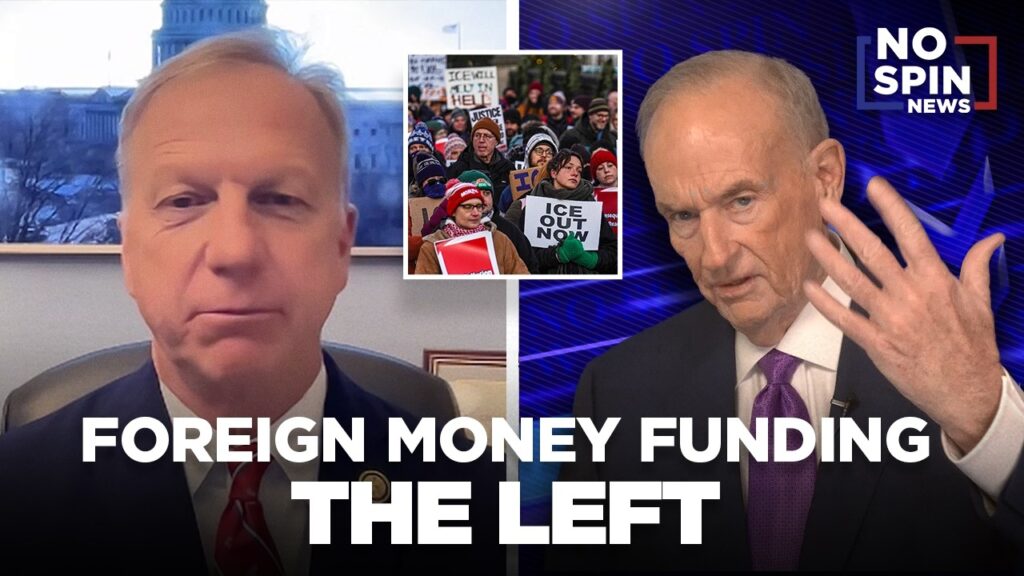
Bill O’Reilly Discusses Foreign Money Funding Far Left Radicals with Congressman Hern stomps into the No Spin Zone like a well-dressed detective, with Bill and Rep. Kevin Hern (R-Oklahoma) unpacking yesterday’s House Ways and Means Committee hearing on alleged foreign cash flowing to far-left groups. He delivers brisk analysis sprinkled with more raised eyebrows than a cat at a vacuum cleaner convention.
The article outlines the hearing’s key moments, the evidence presented about foreign funding, and whether the Department of Justice might begin a crackdown, all wrapped in No Spin News’ signature commentary. Readers should expect policy detail, pointed questions, and the sort of theatrical flair that makes government finance feel almost entertaining.

Episode Context and Participants
Overview of the No Spin Zone segment featuring Bill O’Reilly
The No Spin Zone segment opened like a well-practiced duet: Bill O’Reilly in his familiar perch, ready to prod and puncture, and the guest prepared to parry and persuade. He introduced the topic with the blunt, conversational cadence his audience expects, framing the issue as a national-security-sized headache with liberal seasoning. The segment positioned itself as a follow-up to congressional activity—less a casual chat than a late-night debrief where one man asks the tough questions and the other answers, or at least tries to.
Introduction to Congressman Kevin Hern and his role on the House Ways and Means Committee
Representative Kevin Hern was presented as the policy insider, the committee member who had just spent a day in the hearing room asking questions that sounded, on television, like they belonged in a thriller about money that refuses to wear a name tag. Hern, a Republican from Oklahoma and a member of the House Ways and Means Committee, was cast as someone who combines conservative politics with business credentials. On the show he carried the committee’s concerns into the studio—the same person who asks for receipts in Washington and then, apparently, expects them to be legible.
Date and setting of the discussion and the linked House hearing
The on-air discussion followed a House Ways and Means Committee hearing held the day before, and the segment was staged as an immediate unpacking of what had transpired in that congressional chamber. The setting shifted for viewers between the tidy, studio-lit No Spin Zone and the wood-paneled formality of the committee hearing room described by Hern: a place where microphones hum, legal pads multiply, and every statement is a potential press release.
Relevant affiliations and background of primary speakers and guests
Bill O’Reilly appeared in his role as the host of No Spin News, a commentator with decades of broadcast experience and a reputation for blunt framing. Representative Hern was identified by party (Republican), state (Oklahoma), and committee assignment (Ways and Means), which signals jurisdictional relevance—the committee that handles tax law, benefits, and much of the paperwork that traces money. Guests and commentators mentioned on the show were variously described as financial investigators, nonprofit watchdogs, and committee staff—people whose main hobby is following money until it develops stage fright.
Audience and distribution channels for the video and related clips
The audience for the segment was the usual cocktail of late-night political consumers: viewers who tune into No Spin News, subscribers to the program’s video feed, and followers across social platforms where clips are reposted with commentary. Distribution channels include the program’s primary video platform, social media snippets, and syndications that pass along select clips for headline-hungry audiences. The format assumed an attentive, partisan-leaning core audience, along with casual viewers who stumble in for outrage or entertainment and stay out of habit.
Summary of the Discussion
Central claim: foreign money funding far-left organizations
At the heart of the exchange was the central claim that foreign money—sometimes subtle, sometimes allegedly disguised—is flowing to far-left organizations in the United States. The narrative on air described this funding as both ideational and operational: money that allegedly bankrolls protests, funds advocacy, and underwrites networked organizing. The claim was delivered with the rhetorical flourish of someone announcing an inconvenient relative at Thanksgiving: surprising to some, unsurprising to others, and definitely worth asking who cleared the table.
Main questions posed about DOJ enforcement and congressional oversight
The conversation revolved around two reciprocal questions: will the Department of Justice begin to crack down on these organizations for accepting or soliciting foreign funds, and will Congress ramp up oversight to make the funding pathways more transparent? O’Reilly and Hern pressed the point that enforcement has both legal and political muscles—can the DOJ move, and will it choose to? Congress, they argued, has tools that amount to a watchful stare: hearings, subpoenas, and rule changes. The subtext was an impatience with what they painted as official inaction.
Key assertions made by Representative Hern
Representative Hern asserted that the committee had seen evidence suggesting sizeable flows of foreign capital into domestic progressive causes. He framed these flows as problematic when they influence U.S. policy debates or operations without clear disclosure. Hern contended that these activities merit both congressional scrutiny and potential legal consequences, and he urged the DOJ and other agencies to examine whether existing statutes—FARA or otherwise—had been violated. He also emphasized the need for transparency in nonprofit financing.
Bill O’Reilly’s framing and lines of inquiry during the segment
Bill O’Reilly framed the issue with his characteristic mix of incredulity and moral clarity: foreign money funding domestic activism, he suggested, is a mismatch Americans should know about. He asked pointed questions about the scale of the problem, the specific mechanisms by which funds are allegedly concealed, and whether enforcement would follow complaint. His lines of inquiry pushed for practical consequences—investigations, prosecutions, or legislative fixes—while keeping the tone conversational and punctuated by rhetorical questions designed to land like a gavel.
Immediate reactions and calls to action mentioned on air
On air, reactions ranged from calls for DOJ action to appeals for more aggressive congressional oversight. Hern urged the public and fellow lawmakers to demand follow-up hearings and documentation; O’Reilly called for immediate accountability—if not in court, then at least in the court of public opinion. Both men framed transparency as the immediate remedy, emphasizing subpoenas, document production, and clarity in nonprofit filings as near-term fixes anyone could understand, like putting name tags on a very messy guest list.
Legislative Hearing Overview
Purpose and scope of the House Ways and Means Committee hearing
The House Ways and Means Committee hearing was presented as an audit of influence: to examine whether foreign funding is flowing into U.S. far-left organizations, to determine how those funds are routed, and to assess whether federal laws governing foreign agents, tax-exempt status, and campaign finance are being respected. The scope, as described, straddled criminal statutes and administrative rules, looking both at alleged wrongdoing and at the transparency systems meant to reveal it.
List of witnesses and experts who testified or submitted evidence
The segment referenced testimony from a mix of government staff, nonprofit experts, and financial analysts, but it did not enumerate witness names in detail. Rather than spotlighting specific individuals, O’Reilly and Hern emphasized categories of witnesses—financial forensic experts who traced transactions, nonprofit watchdogs who flagged disclosure gaps, and committee staffers who collected documents. The hearing also drew written submissions and exhibits from outside groups, according to their account.
Procedural actions taken or contemplated during the hearing
Procedurally, the hearing included document requests and public questioning designed to pressure organizations to produce records. Hern and other members discussed the possibility of subpoenas for unreleased documents and contemplated follow-up depositions and more specialized hearings. The implication was that the committee intended to move beyond a single testimony-based gathering into a phased oversight effort, where missing pages would be actively pursued.
Documentary materials and exhibits presented to the committee
Committee members reportedly reviewed a range of documentary materials: bank records, grant agreements, tax filings, and email threads highlighted by staff as potentially indicative of foreign-origin funding streams. On air, these exhibits were described as starting points rather than smoking guns—useful for raising questions but requiring deeper forensic work. The materials were framed as evidence worthy of further inquiry, even if not conclusive on their own.
Summary of any bipartisan or partisan moments from the hearing
The hearing, as recounted, reflected predictable partisan leanings. Republicans, led by Hern and others, pushed aggressively on alleged foreign influence. Democrats were said to have either questioned the premises or emphasized due process and the risk of chilling legitimate advocacy. Moments of bipartisan agreement were reported to be rare but present around procedural transparency: both sides, at least rhetorically, expressed a desire for clear records and compliance with disclosure laws—even if they disagreed on the implications or the urgency.
Key Claims About Foreign Funding
Types of foreign funding alleged to support far-left groups
The claims described a variety of foreign funding types: direct donations from foreign individuals, grants from international foundations, and support routed through multilateral NGOs. Allegations also included funding tied to foreign foundations with philanthropic aims and contributions that arrived via intermediaries, making their origins harder to trace. The segment painted a picture of money that arrives both visibly and furtively.
Examples cited during the segment or hearing to illustrate alleged funding
Specific examples on air were more illustrative than forensic: references to foreign foundations underwriting educational programs in the U.S., reports of grants for activist training, and instances where international NGOs appeared as financial conduits. The conversation favored illustrative vignettes over airtight case studies—using emblematic examples to show patterns rather than listing incontrovertible one-to-one linkages.
Claims about coordination between foreign actors and domestic organizations
There were allegations suggesting coordination: foreign funders not only donated money but collaborated on strategy, messaging, or capacity-building, according to witnesses described by Hern. The claim was that some relationships transcended distant philanthropy and entered the realm of coordinated activity, which raises legal questions under statutes that regulate foreign agents and political influence.
Allegations regarding concealment or obfuscation of donor origins
A recurring allegation was that donor origins were sometimes concealed—intentionally or through complex intermediaries. Committee members raised concerns about the use of shell foundations, the routing of funds through international NGOs or donor-advised funds, and the selective disclosure of grant recipients that obscures ultimate funding sources. The portrayal was of money that arrives with a polite smile but keeps its passport tucked away.
Statements about scale, frequency, and geographic sources of funding
On air, Hern and the show suggested that the phenomenon was nontrivial: multiple streams, recurring patterns, and geographic diversity were all invoked. Europe, international philanthropic networks, and unnamed wealthy foreign donors were cited as recurring sources in the narrative. At the same time, both hosts and guest admitted uncertainty about precise scale, emphasizing patterns over exact sums.
Evidence Presented and Sources
Financial records and transaction trails referenced
The discussion referenced financial records and transaction trails reviewed by committee staff: grant agreements, wire transfers, and bank statements that, according to the account, suggested foreign-origin flows. These records were portrayed as starting points for tracing money but not necessarily conclusive without corroborating metadata and beneficiary confirmations.
Testimony from witnesses and expert analysis cited at the hearing
Witness testimony and expert analysis were highlighted as central to the committee’s understanding. Experts in nonprofit finance and forensic accounting reportedly testified about methods used to route funds and about vulnerabilities in existing disclosure frameworks. The program relayed these witness accounts as reason for follow-up rather than as final judgment.
Publicly available filings, grant reports, and tax documents
Public filings—such as nonprofit IRS Form 990s, grant reports, and other tax documents—were discussed as both helpful and limited. These records provide clues but can be opaque: donor-advised funds, intermediary grants, and international partner names complicate the picture. O’Reilly and Hern emphasized that while these documents are public, their utility depends on willingness to disclose and the granularity of reporting.
Investigative journalism pieces and NGO reports used as sources
Investigative journalism and watchdog NGO reports were invoked as complementary sources that had raised similar concerns in recent years. These pieces were portrayed as useful to compile patterns and give eyes to anomalies in the filings and financial trails. The segment treated investigative reporting as part of a mosaic rather than as individual tiles that alone could decide the narrative.
Gaps in evidence and areas where additional documentation was requested
Both the hearing and the on-air conversation acknowledged gaps: missing metadata in bank records, unnamed intermediaries, and limits in voluntary disclosures. Committee members reportedly requested more extensive documentation, subpoenas where compliance lagged, and clearer accounting from organizations that had received overseas grants. The call for more information was the most emphatic, a polite yet insistent demand for receipts.
Mechanisms of Funding Flow
Direct transfers from foreign entities to US organizations
The simplest mechanism described was straight transfers: a foreign foundation writes a check or wires money to a U.S. nonprofit. When that happens openly and with appropriate disclosure, it’s unremarkable. The concern arises when transfers are in amounts or forms that suggest influence or when the reasons for the grants appear political rather than purely charitable.
Use of charitable foundations and donor-advised funds as intermediaries
More complicated were the intermediary channels: domestic charitable foundations and donor-advised funds that accept money from foreign sources and redistribute it. These vehicles, common in philanthropy, can serve legitimate purposes—yet they can also obscure the original source if reporting requirements are not tightly enforced. The segment described these as legal gray corridors where tracking the original donor is like trying to follow a scent through a closed door.
Grants and partnerships routed through international NGOs
Another pathway is routing through international NGOs that partner with U.S.-based organizations. Funding flows into an international partner and then appears as grants or program payments to U.S. groups. Such partnerships are routine in global philanthropy, but Hern and the committee framed them as potential opportunities for foreign influence when the end-use is political advocacy inside the United States.
Indirect methods such as vendor payments, sponsored events, and media buys
Money can also move indirectly: paying vendors who provide services to activist networks, sponsoring conferences where strategy is hashed out, and buying media or advertising to amplify messages. These transactions can be harder to classify as direct grants, yet they materially assist the operations of organizations—a subtlety that complicates enforcement and disclosure.
Emerging channels including cryptocurrency, crowdfunding, and informal networks
Finally, the conversation turned to emerging channels: cryptocurrency transfers, international crowdfunding, and informal networks that use personal accounts or fintech platforms. These methods promise speed and flexibility but also create tracking challenges. The narrative was that as enforcement becomes more rigorous in traditional channels, actors may adopt newer conduits that strain existing legal frameworks.
Legal and Regulatory Framework
Overview of relevant US laws, including FARA and campaign finance rules
The legal backdrop includes the Foreign Agents Registration Act (FARA), designed to require registration of those acting as agents of foreign principals, and campaign finance laws that regulate contributions to political campaigns. FARA’s application to modern grant-making and advocacy organizations is complex, and campaign finance statutes address some but not all forms of advocacy spending. The on-air discussion acknowledged that statutes exist, but their borders are fuzzy when applied to modern nonprofit networks.
Tax regulations governing nonprofit grants and disclosure obligations
Tax laws governing 501(c)(3) and 501(c)(4) organizations set disclosure obligations and limit certain political activities for charitable entities. Nonprofits must file Form 990s, reporting grants and revenues, but the level of donor detail required varies. The show highlighted how these tax rules shape, but do not fully illuminate, the flow of funds—especially when intermediaries or foreign partners are involved.
Role of federal agencies in monitoring foreign influence and funding
Federal agencies implicated in monitoring include the Department of Justice (for FARA enforcement), the IRS (for tax compliance), and financial regulators like Treasury’s FinCEN (for anti-money-laundering and beneficial ownership tracking). The segment suggested that coordination among these agencies is crucial, yet organizational silos and resource constraints complicate comprehensive oversight.
Legal thresholds for proving improper foreign influence or criminality
Proving improper foreign influence legally requires showing that a person acted as an agent of a foreign principal without registering, or that money was used in ways that violated campaign finance or anti-money-laundering laws. The threshold for criminality is high: intent, knowledge, and clear statutory violation. The show acknowledged these burdens, noting that unmasking intent across complex funding routes is difficult but not impossible.
Identified gaps or ambiguities in current statutes discussed on the show
The discussion highlighted ambiguities: whether modern advocacy partnerships fall under FARA, how donor-advised funds should disclose foreign sources, and whether current campaign finance rules capture non-electoral advocacy. These gaps create gray zones where activity may be ethically questionable but not clearly illegal, prompting the committee’s insistence on legislative clarification or enhanced enforcement guidance.
DOJ’s Potential Role and Limitations
Legal authorities the Department of Justice can invoke in investigations
The Department of Justice can invoke FARA, money-laundering statutes, and other criminal statutes when investigations reveal violations. It can bring charges, negotiate settlements, and refer matters to other agencies for civil enforcement. The DOJ also has subpoena power through grand juries and investigative teams that can compel documents and testimony when predicate evidence exists.
Distinction between civil enforcement, criminal prosecution, and regulatory action
The conversation delineated enforcement modalities: civil enforcement (fines, injunctions, corrective filings), criminal prosecution (requiring proof beyond reasonable doubt), and regulatory action via agencies like the IRS (revocation of tax-exempt status, audits). Each path requires different evidentiary standards and yields different remedies. The tone was practical: enforcement is possible, but not always straightforward.
Past DOJ cases or precedents relevant to foreign funding and political activity
The show referenced historical examples where FARA and related laws were used to address foreign influence, illustrating that the DOJ does, in principle, enforce these statutes. Those precedents suggest that when facts are clear and illicit intent can be shown, prosecutions or robust civil actions follow. However, the hosts also noted that most cases settle administratively rather than end up in dramatic courtroom scenes.
Resource, jurisdictional, and evidentiary challenges the DOJ may face
Obstacles to DOJ action include limited resources, jurisdictional complexity when foreign entities are involved, and the difficulty of assembling admissible evidence across borders. Investigators may require cooperation from foreign governments or banking institutions, which is not always forthcoming. These practical limits shape the pace and scope of any enforcement response.
Questions about political will and the independence of enforcement decisions
Finally, the show acknowledged a perennial question: enforcement is not just a matter of law but of will. Political considerations can influence priorities, and the independence of prosecutorial decisions is often scrutinized in high-profile cases. Hern and O’Reilly framed this as a matter of public confidence—if citizens believe enforcement is selective, the law’s legitimacy suffers.
Political and Policy Responses
Proposed legislative remedies discussed by guests or referenced from the hearing
Legislative ideas floated included tightening FARA definitions, requiring more granular reporting for donor-advised funds, and amending tax rules to force clearer disclosure of foreign-origin grants. Proposals also included creating statutory presumptions that certain types of cross-border funding supporting political advocacy trigger registration or special reporting requirements.
Oversight measures and committee follow-ups recommended by lawmakers
Lawmakers described a follow-up approach: additional hearings, targeted subpoenas, and requests for internal communications from organizations that appeared in the exhibits. The committee signaled intent to pursue multi-stage oversight, bringing in technical witnesses to explain payment flows and legal experts to discuss statutory gaps.
Administrative actions or guidance agencies could issue to improve transparency
Agencies could issue clarifying guidance on FARA registration triggers, tighten IRS reporting requirements, and enhance FinCEN rules on beneficial ownership and cross-border transfers. The discussion suggested that administrative guidance could be a more nimble first step than statute-changing legislation.
Bipartisan and partisan policy divides on regulating foreign funding
Policy divides were predictable: some lawmakers argued for robust rules to protect sovereignty and democratic debate; others warned about overreach and the chilling effect on legitimate international cooperation. While transparency drew some bipartisan nods, enforcement scope and statutory fixes remained divisive.
Potential unintended consequences of proposed policy responses
The segment acknowledged unintended consequences: stricter rules could burden legitimate philanthropy, chill academic and cultural exchange, and create compliance costs that favor large organizations over small grassroots groups. Policymakers were urged to calibrate regulations to target abuse without dismantling benign international cooperation.
Conclusion
Recap of the central themes discussed by Bill O’Reilly and Representative Hern
In the No Spin Zone, Bill O’Reilly and Representative Hern rehearsed a simple, insistent thesis: foreign money may be flowing into far-left U.S. organizations in ways that merit scrutiny, transparency, and possibly enforcement. The themes were consistent—concern about hidden influence, a call for documentary clarity, and a demand that enforcement agencies and Congress act.
Summary of evidentiary strengths and remaining uncertainties
The evidentiary picture, as described, offered intriguing leads: transaction records, grant reports, and witness accounts that suggest patterns worth examining. But crucial uncertainties remain—scale of support, directness of coordination, and the intent behind funding. The materials cited were enough to light a fuse under further inquiry, not yet to detonate a legal conclusion.
Importance of measured policy responses that protect democracy and civil liberties
Both the hearing and the studio conversation underscored the need for measured responses. Strong transparency measures and thoughtful enforcement can protect democratic processes without trampling free association or charitable giving. The tone advocated for balanced policy that discerns between influence that’s benign and influence that’s covert and potentially injurious to self-governance.
Need for transparency, thorough investigation, and public accountability
The takeaway was procedural as well as political: transparency must improve, investigations must be thorough and legalistic rather than performative, and public accountability should be the lodestar. Subpoenas, audits, and better reporting were described as the practical tools to achieve that clarity.
Final takeaways and recommended priorities for policymakers, media, and the public
The final prescription was modest and pointed: policymakers should prioritize clarifying law and closing disclosure gaps; the DOJ and agencies should coordinate to follow money where it leads; the media should continue investigative work without conflating accusation with proof; and the public should demand records and resist knee-jerk conclusions. If nothing else, the exchange reminded viewers that money talks in campaigns and advocacy—and sometimes it prefers to whisper. The remedy, collectively, is daylight, methodical inquiry, and a healthy skepticism that doesn’t forget the rules of evidence in favor of the warm glow of a good headline.
Rep. Kevin Hern (R-Oklahoma) enters the No Spin Zone to discuss yesterday’s House Ways and Means Committee hearing on foreign money funding far-left groups and on whether the DOJ will start cracking down on these organizations.
Viewers can subscribe to never miss an episode of No Spin News with Bill O’Reilly: / @billoreilly
Viewers can watch full episodes of No Spin News here: • Bill O’Reilly’s No Spin News
Viewers can watch clips of No Spin News here: • No Spin News | Clips
Bill O’Reilly’s official YouTube channel – No Spin. Viewers can subscribe for No Spin News each night, exclusive clips, and a one-of-a-kind brand of news analysis each night.
Become an O’Reilly Premium Member:
Buy Bill’s New Book Available Now:
Visit Bill’s Website:
Viewers can follow Bill on Twitter: / billoreilly
Viewers can follow No Spin News on Twitter: / nospinnews
Viewers can like Bill on Facebook: / billoreillyofficial