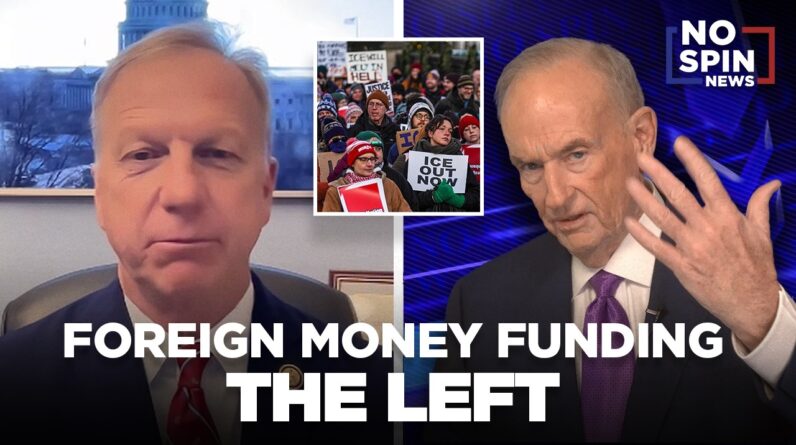
Bill O’Reilly storms the screen with a theatrical “Come on Back Here!” aimed squarely at Neville Roy Singham, treating the No Spin News stage like a backyard barbecue where accusations are tossed like hotdogs. The clip mixes pointed commentary, archival snippets, and that trademark eyebrow-raising certainty viewers either cheer or quietly mute.
This piece will recap the exchange, summarize the key allegations about Singham’s supposed communist links, and place the segment in the larger context of No Spin News’ performative style. It will also note audience reactions and consider whether the moment is journalism or late-night political wrestling.

Headline and Central Claim
Precise wording of Bill O’Reilly’s message: ‘Come on Back Here!’ and its immediate implications
Bill O’Reilly leaned into the kind of imperious, late-night summons that sounds equal parts schoolyard taunt and town crier: “Come on Back Here!” The phrase functions as an invitation wrapped in accusation — a demand that Neville Roy Singham return to account for his alleged ideas and alleged affiliations. It implies not just a physical return but a public reckoning, as if O’Reilly were calling someone back from a garden party where inconvenient guests mingle with power.
Summary of the central accusation or appeal directed at Neville Roy Singham
At its core, O’Reilly’s message accuses Singham of carrying an ideological banner that O’Reilly labels “communist” and of using his wealth to shape media and public opinion in ways that supposedly favor foreign, specifically Chinese, interests. The appeal is both moral and civic: O’Reilly frames the question as one of national integrity and media transparency, urging viewers to scrutinize who funds and influences what they read and watch.
How the headline frames the story and sets audience expectations
The headline frames the story as a confrontation. It primes the audience to expect drama, a reveal, and a clear villain. For O’Reilly’s viewers, the expectation is confirmation — evidence of subterfuge and a mastermind behind it. For neutral or skeptical viewers, the headline telegraphs combative rhetoric and a demand for proof. In either case, it sets up a showdown rather than a slow, forensic investigation.
Immediate emotional and rhetorical effect intended by the phrase
“Come on Back Here!” is built to provoke. It aims to stoke indignation, curiosity, and a readiness to believe the worst. Rhetorically, it employs direct address and an imperative, dragging the story into a soap-opera immediacy. The emotional effect is a cocktail of righteous anger and voyeuristic anticipation; viewers feel invited to watch a public unmasking, as if a curtain is about to be pulled and a puppet revealed.
Context: Bill O’Reilly and No Spin News
Overview of Bill O’Reilly’s media career and public persona
Bill O’Reilly is a veteran media figure with a long history in broadcast news, opinion shows, and cable television. His public persona is that of a combative commentator who favors plain-speaking analysis, often adopting the role of a moral referee. He cultivated a broad national audience over decades, bringing a confrontational style that fans see as clarity and critics see as theatrical bluster. His career is a catalogue of high ratings, controversies, and a flair for turning outrage into programming.
Format and reach of No Spin News, including YouTube and social platforms
No Spin News is his direct-to-audience platform where he dispenses monologues, interviews, and commentary clips. The format is compact, opinion-forward, and optimized for online sharing: short, punchy episodes and bite-sized clips that feed social platforms. While it lacks the institutional heft of a broadcast network, it benefits from the agility of digital distribution and the loyalty of an established fanbase. The reach may be smaller than peak broadcast fame but still influential among specific demographics who follow his content on streaming and social media.
Typical editorial stance and audience demographics of O’Reilly’s programs
O’Reilly’s editorial stance skews conservative and nationalist in tone, prioritizing issues of law and order, skepticism toward progressive institutions, and a suspicion of foreign influence. His core audience tends to be older, politically conservative, and attuned to culture-war framing. The show’s rhetorical style often centers on moral clarity and indignation, aiming to reassure viewers that moral and political confusion has identifiable culprits.
How this episode fits within O’Reilly’s broader messaging and themes
The Singham episode slots easily into familiar themes: media integrity, foreign influence, and ideological threats. It combines O’Reilly’s taste for naming villains with his recurring concern about media actors who, in his view, shape public conversation in opaque ways. This is less an investigatory pivot and more a continuation of his brand: call out a target, expose alleged influence, and mobilize audience suspicion.
Who Is Neville Roy Singham?
Biographical background: education, career milestones, and business ventures
Neville Roy Singham is a tech entrepreneur and philanthropist who made his mark in the software and services industry. He is known for founding a successful technology company and later redirecting his attention toward media, philanthropy, and social initiatives. His trajectory follows a familiar arc: from coder and firm-builder to donor and backroom funder, with an interest in using resources to amplify ideas he believes in.
Overview of organizations, nonprofits, and media projects associated with Singham
Singham has been linked to a network of nonprofits, media projects, and grantmaking activities that promote independent journalism, cultural production, and policy research. Some of these efforts concentrate on content production, support for documentary work, and funding for outlets that describe themselves as progressive or independent. The exact roster of supported organizations has been a subject of reporting and dispute, and the structure of his philanthropic efforts appears to involve a mix of direct donations and partnerships.
Public statements and self-described political or philosophical positions
Publicly, Singham has characterized himself as committed to equitable development, human rights, and critiques of neoliberal economic arrangements. He has expressed sympathy for political ideas that prioritize communal welfare and structural reform. Whether one calls those positions “leftist,” “progressive,” or “communist” depends on political thresholds and definitions — a distinction that has fueled much of the debate around O’Reilly’s claim.
Reputation among journalists, academics, and civil society actors
Among journalists and academics, Singham is a contested figure. Supporters stress his contributions to independent media funding and cultural projects; critics point to opaque funding mechanisms and potential alignment with state narratives. Civil society actors who receive funding or collaborate with his initiatives may praise his generosity; others worry about the strings attached to concentrated philanthropic capital. Overall, his reputation is mixed: admired by some for generosity and criticized by others for perceived secrecy.
Allegations and Characterization: ‘Communist’ Claim Explained
Specific allegations made by Bill O’Reilly and how he defines ‘communist’ in this context
O’Reilly’s central allegation is that Singham is a “communist” who uses his wealth to promote narratives favorable to the Chinese Communist Party (CCP) and to undermine Western democratic discourse. In O’Reilly’s usage, “communist” seems to function as both an ideological label and a charge of operational alignment — suggesting not merely sympathy for leftist ideas but active collaboration with a foreign authoritarian project.
Sources O’Reilly cites to support the characterization and their provenance
In the segment, O’Reilly references reporting, purported financial trails, and public statements that he interprets as indicating alignment. He leans on investigative threads that trace donations, editorial influence, or content partnerships back to entities linked to Singham. The provenance of these sources varies — some are mainstream investigative reports, others are leak-based claims or interpretations of public records. The litany of citations aims to create a mosaic of evidence, though each tile invites scrutiny.
Distinction between ideological labels, political advocacy, and alleged operational ties
It matters, legally and analytically, to separate personal ideology from operational ties. Calling someone a “communist” in the sense of an ideological position is different from asserting that they have contractual or clandestine ties to a foreign party-state. Political advocacy — financing voices that critique capitalism, for example — is protected speech in many democracies. Alleged operational ties, if proven, raise questions of influence and national security. O’Reilly blends these categories rhetorically, which heightens alarm but complicates factual assessment.
Singham’s public responses, denials, or clarifications (if any)
Singham and his representatives have, at times, offered responses stressing philanthropic intent, advocacy for social justice, and respect for journalistic independence. They have pushed back on characterizations that suggest he is an agent of a foreign government, framing his work as ideological solidarity rather than covert operation. Where he has remained publicly silent, intermediaries and funded organizations have issued statements about independence and editorial control.
Funding Networks and Media Influence
Catalog of media outlets, production companies, and initiatives receiving financial support
Reports attribute funding to a range of outlets and media projects described as independent, investigative, or progressive. The roster includes documentary producers, online publications, and nonprofit media initiatives. Public reporting has sometimes named specific projects that received grants or production support, while other times it describes a pattern of funding that spans cultural and informational domains.
Mechanisms used for funding (grants, partnerships, philanthropy) and transparency concerns
Singham’s funding appears to travel through a variety of mechanisms: direct grants, foundation channels, partnerships with production companies, and collaborative funding pools. Transparency concerns arise when donations route through multiple intermediaries, when grant conditions are opaque, or when recipients do not disclose major donors. Critics argue that such structures can obscure the origin of funds and create unexamined dependencies.
Examples of content or narratives alleged to reflect funder influence
Observers have pointed to content that critiques Western foreign policy, highlights China’s development model positively, or emphasizes structural critiques of capitalism as examples that could align with funder preferences. Supporters argue that these narratives are legitimate lines of inquiry rather than puppetry. The evidentiary challenge is to determine whether editorial decisions followed journalistic judgment or donor direction — a distinction that often requires internal documents or whistleblower testimony to resolve.
How funding patterns are used to assess potential bias or strategic goals
Analysts assess potential bias by mapping funding flows against editorial output: timing of grants, similarity of narrative frames, and organizational dependence. Consistent patterns can suggest strategic goals, but correlation is not causation. A media organization funded by a donor with particular beliefs might independently pursue similar themes because of editorial agreement rather than direct instruction. Thus, funding patterns are suggestive but rarely conclusive on their own.
Alleged Connections with China and the Chinese Communist Party
Nature of claims about ties to China or the Chinese Communist Party as presented by O’Reilly
O’Reilly frames the alleged ties as ideological affinity that transforms into practical collaboration — suggesting that Singham’s funding network amplifies narratives favorable to the CCP and that those narratives serve Beijing’s strategic interests. The claim is weighty: it implies that private philanthropy has become an informal arm of foreign influence, shaping discourse in ways that advantage another state.
Documentary or reporting evidence cited linking Singham to Chinese entities
Reporting on this question ranges from documented donations to entities with China ties, to emails and transaction records purporting to show coordination, to analyses of content overlap. Some investigative pieces claim to have traced payments or partnerships that link back to organizations operating in or with Chinese partners. Other reports emphasize the absence of a clear paper trail tying Singham directly to the party-state, leaving room for debate.
Counterarguments and explanations from independent analysts or involved parties
Independent analysts caution against conflating sympathy for aspects of China’s governance with operational control by the CCP. They point out the complexity of transnational philanthropy and the common practice of funding global media projects without direct editorial oversight. Involved parties often assert editorial independence, and some commentators note that many critiques of Western policy can emerge organically from scholars and journalists without foreign prompting.
Implications of any verified ties for international information operations and policy
If concrete operational ties were verified — contracts, directives, or covert coordination with a foreign government — the implications would be serious, implicating information operations and potentially triggering legal and policy responses. Policymakers would need to weigh national security concerns against free speech protections, while media institutions would face intense pressure to disclose funding sources and strengthen firewalls between donors and editorial decisions.
Analysis of O’Reilly’s Rhetoric and Persuasive Strategy
Rhetorical devices used in the message: direct address, imperative language, framing
O’Reilly uses plain, blunt devices: direct address (“Come on Back Here!”), rhetorical questions, and framing that casts Singham as a local villain in a global drama. The imperative language short-circuits nuance and invites the audience into a posture of collective accusation. This kind of pedagogy — telling viewers what to feel and whom to distrust — is a hallmark of persuasive punditry.
Appeals to authority, fear, patriotism, or moral outrage within the segment
The rhetoric leans on appeals to authority (positioning himself as a truth-teller), fear (foreign influence as existential risk), and patriotism (defending national discourse). Moral outrage is stoked through suggestive linkage rather than conclusive proof, asking viewers to imagine an enemy within who betrays public trust. The emotional calculus is simple: outrage breeds attention, and attention reinforces the messenger.
Target audiences and likely behavioral responses O’Reilly aims to provoke
The primary audience is his existing base: viewers predisposed to suspect foreign meddling and skeptical of progressive media. He also aims to recruit fence-sitters by promising revelations. Behavioral responses sought include heightened suspicion of certain media outlets, calls for accountability, and social sharing that amplifies the accusation. For some, it may trigger calls for regulatory oversight; for others, affirmation of prior beliefs.
Potential risks and benefits of using confrontational public messaging
Confrontational messaging mobilizes supporters and generates visibility, but it risks oversimplification and misattribution. Benefits include spotlighting potential problems and prompting investigations. Risks include reputational damage if accusations are unproven, chilling effects on journalism, and the erosion of public trust in media generally. The tactic can also deepen polarization, turning complex verification into a partisan battle.
Fact-Checking and Evidence Assessment
Primary documents and reporting to verify claims: leaks, financial records, and official statements
Verifying claims requires primary materials: bank records, grant agreements, internal emails, and official statements from involved entities. Leaked documents, if authenticated, can be revelatory, but they require provenance checks. Public records, tax filings, and corporate disclosures also provide baseline evidence for tracing funding flows. The gold standard is a combination of documentary proof and corroborating testimony.
Where independent journalism corroborates, disputes, or leaves questions open
Independent journalism has both corroborated elements of the narrative — such as instances of funding to certain projects — and disputed more expansive claims that imply direct CCP orchestration. Many reputable outlets have published partial accounts that illuminate pieces of the puzzle while leaving the larger picture contested. The pattern is one of partial verification and persistent uncertainty.
Methodological challenges in tracing funding and influence across borders
Tracing cross-border funding is difficult: donations often travel through intermediaries, legal entities in different jurisdictions, and nonprofit channels that shield donor identity. Currency conversions, shell entities, and cultural nonprofit structures complicate the trail. Moreover, influence is not a simple dollar-to-message ratio; it is mediated by institutional norms, editorial culture, and mutual ideological alignment, making causation hard to prove.
Recommended steps for readers to independently verify contested assertions
Readers should seek original reporting, request primary documents where possible, and look for corroboration across multiple independent sources. They can review nonprofit filings, scrutinize donor disclosures, and compare timelines of funding to content publication. Skepticism is healthy, but so is openness to evidence; the goal is to triangulate rather than rely on a single loud voice.
Legal and Ethical Considerations
Defamation risks and legal thresholds for labeling someone a ‘communist’ in public media
Labeling someone a “communist” is typically an expression of opinion and often protected speech, but defamatory claims arise when the label implies false, verifiable facts that damage reputation — for example, alleging covert wrongdoing or illegal acts. In the U.S., public figures face a high bar for defamation claims; they must show actual malice. Nonetheless, broadcasters must be cautious: mixing ideological labeling with assertions of illegal collaboration can cross legal thresholds.
Journalistic ethics related to sourcing, context, and proportionality in accusations
Journalistic ethics demand careful sourcing, transparency about evidence, and proportionality: the seriousness of an accusation should match the strength of the evidence. Presenting allegations as fact without corroboration violates core norms. Ethical reporters also give subjects an opportunity to respond and contextualize findings so audiences can judge credibility.
Privacy, national security, and whistleblower protections relevant to the story
Investigations into cross-border influence may intersect with privacy concerns and national security. Whistleblowers who provide documents may be protected by legal frameworks, but they can also face retaliation. Journalists must balance the public interest in disclosure against potential harm to individuals and operations. Responsible reporting navigates these tensions with legal counsel and ethical reflection.
Platform policies and responsibilities for moderating potentially incendiary claims
Platforms hosting commentary — especially when it alleges foreign collusion — must apply content policies that balance free expression with preventing harassment and misinformation. They face pressure to remove demonstrably false claims, label contested content, or provide context. At the same time, overzealous moderation risks accusations of political bias. Platforms are thus arbiters in a contentious space and must tread a fine line.
Conclusion
Recap of the central issues raised by Bill O’Reilly’s message to Neville Roy Singham
O’Reilly’s “Come on Back Here!” is a high-decibel call for accountability that accuses Neville Roy Singham of ideological alignment and influence operations tied to China. The episode raises substantive questions about philanthropy, media influence, and the transparency of funding networks, while also highlighting the rhetorical strategies used to frame such issues.
Summary of open questions and areas where evidence remains contested
Key questions remain open: the extent and nature of any operational ties to Chinese entities, whether funding influenced editorial decisions, and how transparent the funding mechanisms truly are. Independent reporting has confirmed some funding flows but has not definitively proven covert coordination with a foreign government. The evidentiary record is partial and contested.
Call for balanced, evidence-based inquiry and restraint from premature judgments
The situation calls for measured inquiry: rigorous, document-based journalism; transparency from funders and recipients; and restraint from public figures who may conflate ideology with illicit action. Audiences benefit when allegations are pursued with patience and precision rather than headlines built for outrage.
Final reflection on the broader stakes for truth, media integrity, and democratic discourse
At stake is more than one man’s reputation; it is the health of public discourse. When accusations fly without clear evidence, the public grows skeptical — not just of the accused, but of the institutions that mediate truth. Conversely, when influence is opaque and unchecked, democracy suffers. The remedy is old-fashioned: better reporting, clearer disclosures, and a culture that prizes verification over vindication. In the meantime, viewers can chuckle at the theatricality, hold their skepticism close, and ask for the receipts.
Subscribe to never miss an episode of No Spin News with Bill O’Reilly: / @billoreilly
Watch full episodes of No Spin News here: • Bill O’Reilly’s No Spin News
Watch clips of No Spin News here: • No Spin News | Clips
Bill O’Reilly’s official YouTube channel – No Spin. Subscribe for No Spin News each night, exclusive clips, and a one-of-a-kind brand of news analysis each night.
Become an O’Reilly Premium Member:
Buy Bill’s New Book Available Now:
Visit Bill’s Website:
Follow Bill on Twitter: / billoreilly
Follow No Spin News on Twitter: / nospinnews
Like Bill on Facebook: / billoreillyofficial