President Trump signed the Milk for Healthy Kids Act to expand whole milk choice in schools, turning a bright spotlight on school nutrition and the livelihoods of American dairy farmers. The article outlines the law’s passage, his remarks defending choice in both school meals and media, and the immediate implications for millions of students and local dairy communities.
A video by One America News Network captures the ceremony and key soundbites, and the piece summarizes policy details, reactions from families and agricultural stakeholders, and what schools can expect to change. It also considers how restored beverage options may influence school nutrition programs and the rural economies that supply them.

Summary of the Milk for Healthy Kids Act and Presidential Signing
Overview of the law’s main purpose to expand whole milk choice in schools
The Milk for Healthy Kids Act is presented as a law meant to change a small but symbolic piece of daily life for millions of children: the milk poured into cafeteria trays. Its stated purpose is simple and direct—allow schools that participate in federal nutrition programs to offer whole milk as an option alongside lower‑fat varieties. Framed as an expansion of choice, the law aims to give families and students the ability to select milk with the fat content they prefer while maintaining the infrastructure of federally supported school meal programs.
Details of President Trump’s signing ceremony and public remarks
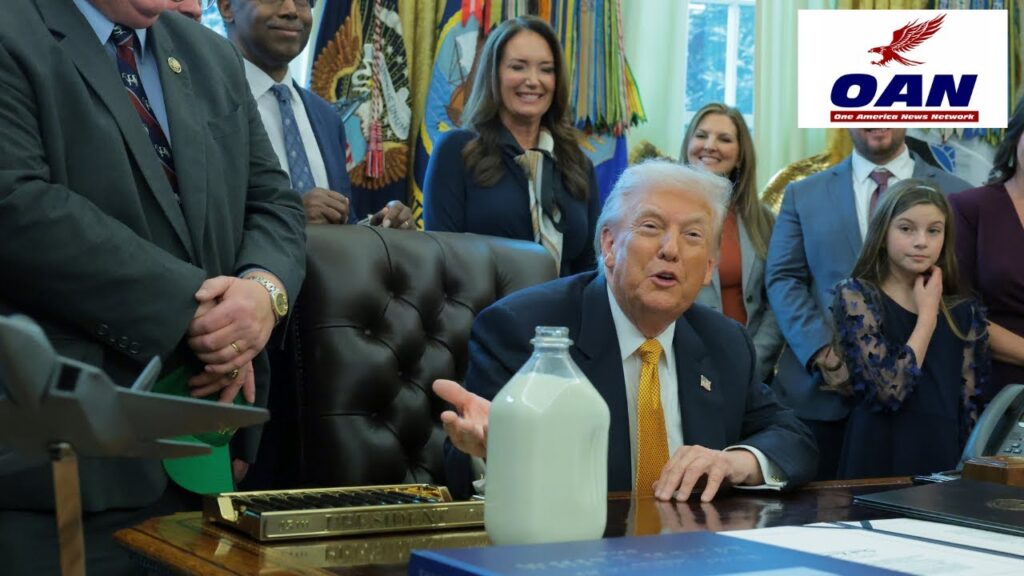
At the signing ceremony, the moment was staged with the choreography common to such events: a lectern, a ring of cameras, and a handful of dairy farmers whose faces carried the quiet patience of people who measure success by seasons. He signed the bill amid applause and posed for photographs, then turned to speak about the broader themes he wanted the moment to represent. He praised the law for giving families and students more options in school nutrition and used the occasion to denounce what he called left‑wing censorship in media, linking the idea of choice in school milk to a larger narrative about freedom of speech and information. His remarks blended policy detail with rhetorical flourish, and the visual of the pen scratching ink into law served as a tangible punctuation mark for both the policy and his messaging.
Reference to the One America News Network video and media coverage
One America News Network captured the signing and promoted highlights of the event, emphasizing the administration’s framing: that the law supports American dairy farmers and expands nutritious options for children. Media accounts varied in tone and emphasis—some outlets foregrounded the ceremony’s political messaging and its cultural symbolism, others focused on the practical implications for school nutrition and public health debate. The OAN video became one of several pieces of media used by allies to amplify the message, while mainstream and local outlets offered a wider range of analysis, reflecting the often divided media landscape into which the law was introduced.
Immediate legal effect and scope of permitted changes in school meal programs
Legally, the statute took effect immediately upon the President’s signature, creating a new permission within the rules that govern federally supported school nutrition programs. It did not mandate universal changes to menus; rather, it authorized school food authorities to include whole milk as an allowable option and clarified that purchases could be eligible for federal reimbursement where applicable. The change applies to schools participating in federal meal programs and sets a framework for optional adoption, leaving room for local discretion in how, when, and whether whole milk appears on the line.
Legislative Background and Path to Passage
Origins of the bill in Congress and key sponsors and co-sponsors
The bill originated in Congress amid persistent advocacy from representatives of dairy‑producing regions and from interest groups tied to agricultural communities. Its sponsors and co‑sponsors tended to be lawmakers who emphasized rural economic interests and the importance of supporting domestic producers. The legislation was portrayed by proponents as a modest fix to an existing rule rather than a sweeping overhaul, introduced with the rhetoric of common sense and responsiveness to constituents who felt their product and way of life deserved government consideration.
Committee actions, hearings, and bipartisan or partisan dynamics
In committee, the bill moved through hearings and briefings where lawmakers and witnesses debated both economic and nutritional dimensions. Those hearings reflected the broader partisan landscape: some members framed the measure as a pro‑farmer, pro‑choice action that deserved quick passage; others raised fiscal and public health questions, pressing for data and guidance on implementation. The committee stage mixed procedural work with moments of real disagreement, but enough members found common ground—often on the economic argument for supporting dairy communities—to advance the bill to the floor.
Key amendments and compromise language adopted during markup
During markup, lawmakers introduced amendments intended to clarify the law’s scope and to ensure local control. Compromise language emerged to stress that whole milk would be an option, not a mandate, and to affirm the continued applicability of broader school nutrition standards. Other amendments focused on reporting and transparency—asking that school districts keep records of milk purchases and reimbursements so federal agencies could monitor fiscal impacts. Those adjustments were designed to reassure skeptics that this change would not dismantle established nutrition rules overnight.
Final votes in the House and Senate and timeline from introduction to enactment
From introduction to presidential signature, the bill’s passage followed the familiar arc of contemporary legislation: introduction, committee consideration, floor debate and votes, reconciliation of any differences, and final enrollment for the President’s signature. Both chambers ultimately approved the measure, reflecting a coalition that blended agricultural advocates, certain conservative and rural lawmakers, and some pragmatic centrists. The timeline was measured in months rather than years—a pace that matched the bill’s small scale and the focused interest of its backers.
Key Provisions of the Act
Authorization for schools participating in federal programs to offer whole milk as an option
The core provision authorizes schools participating in federal child nutrition programs to offer whole milk as a permissible beverage choice. It adjusts the catalog of allowable milk options so that school food authorities may choose to stock whole milk alongside low‑fat and nonfat varieties, enabling local preferences to shape offerings at the cafeteria line.
Clarification on eligibility of whole milk for federal reimbursement under school nutrition programs
The law clarifies that purchases of whole milk can be eligible for federal reimbursement in the same manner as other milk varieties, provided purchases and meal service meet established program requirements. This clarification was intended to remove ambiguity for procurement officers and to ensure that districts serving federally reimbursed meals would not face financial penalties simply because they opted to provide whole milk.
Rules about optional versus required availability of whole milk in school meal offerings
Importantly, the statute specifies—or as adopted through its implementing guidance makes clear—that whole milk is an optional offering. Schools are not required to provide whole milk on every menu or to replace existing lower‑fat options. That deference to local control leaves the final decision about availability to school districts and local food authorities, reflecting the law’s emphasis on choice rather than compulsion.
Any labeling, portion size, and nutritional information requirements included in the statute
The act itself includes basic expectations around labeling and portion control: schools must identify milk types on menus and reconcile portion sizes with federal meal pattern standards to ensure overall nutritional compliance. The law also anticipates that schools will provide parents and students with information about milk options and their nutritional content; however, it leaves detailed labeling, portion sizing, and educational materials to subsequent guidance from federal agencies and local policy decisions.
Nutrition Science and Dietary Considerations
Nutritional profile differences between whole milk and lower-fat milk options
Whole milk contains a higher percentage of milk fat than low‑fat (1%) and nonfat (skim) milk, and with that fat comes additional calories per serving. Beyond calories and fat, milk provides a package of nutrients—high‑quality protein, calcium, vitamin D (often fortified), potassium, and other micronutrients—that are important for growing children. The difference between whole and lower‑fat milk is therefore not only in energy but in how that energy is delivered within a matrix of nutrients.
Evidence on saturated fat, calories, and essential nutrients such as calcium and vitamin D
Whole milk has greater saturated fat content than reduced‑fat alternatives, and saturated fat has long been scrutinized for its relationship to cardiovascular disease. At the same time, milk is an important dietary source of calcium and, when fortified, vitamin D—nutrients critical to bone development in childhood. Nutrition researchers and policy makers balance these facts, noting that while saturated fat intake is a prudent concern across the lifespan, the contribution of milk to overall nutrient intake must be considered in the context of a child’s entire diet.
Research findings on whole milk consumption and childhood weight, growth, and satiety
The research literature on whole milk and childhood weight is mixed. Some observational studies have found no clear association between whole milk consumption and higher adiposity in children; others suggest that full‑fat dairy may be linked to greater satiety and different patterns of nutrient intake that do not necessarily translate into weight gain. Randomized controlled trials are limited. The complexity of dietary patterns, activity levels, and socioeconomic factors makes causal claims difficult. Experts often agree that more targeted research and careful monitoring are warranted as policy changes alter consumption patterns.
Guidance from major public health authorities and nutrition organizations regarding milk fat
Major public health bodies and professional nutrition organizations have tended to recommend lower‑fat milk options for children older than two in the interest of limiting saturated fat and calories, though recommendations vary across groups and over time. Some pediatric and nutrition experts emphasize whole milk’s role in certain developmental contexts, while others prioritize reductions in saturated fat for long‑term cardiovascular health. The resulting landscape is one of nuanced guidance rather than unanimous agreement, which is part of why policy decisions about milk in schools are often contested.
Implications for Students and Families
How expanded whole milk choice affects parental preferences and student intake
Giving parents and students the option of whole milk reshapes an everyday decision about what to drink at school into one that feels more personal. For some families, it will align school offerings with home practice and cultural preferences; for others, it may raise questions about consistency with household dietary rules. The visible presence of whole milk may subtly shift student intake patterns by increasing acceptance and consumption of milk overall, particularly among children who prefer the taste and texture of higher‑fat milk.
Potential benefits related to taste, acceptance of school meals, and nutrient intake
Proponents argue that whole milk can improve the palatability of school meals, thereby increasing participation in the meal programs and improving nutrient consumption among children who might otherwise skip milk. Taste is a practical variable in nutrition: a child who drinks milk is more likely to receive calcium, vitamin D, and protein from that source. For many school food programs struggling with plate waste and low participation, even modest increases in acceptance can translate into meaningful nutritional gains.
Concerns families might have about calories and long-term health outcomes
Conversely, some families will worry that offering whole milk normalizes higher‑fat choices for children and could contribute to excess calorie intake over time. Those concerns are particularly salient for families with histories of obesity, heart disease, or metabolic conditions. For parents who want their children to consume lower‑fat milk, the law’s optional framework preserves that choice, but the social dynamics of a cafeteria—where peers, convenience, and default options matter—may complicate individual intentions.
Communication strategies schools can use to inform families about the change
Clear, empathetic communication will be essential. Schools can send informational letters, update websites and menus, and host brief tastings or Q&A sessions that explain the rationale, nutritional facts, and how choices will be presented. Emphasizing that whole milk is an option—not a mandate—and explaining portion sizes, reimbursement rules, and how the change fits within overall meal patterns will help parents make informed decisions. Framing the information in a way that respects diverse family preferences and avoids judgment will be especially effective.
Impact on American Dairy Farmers and the Dairy Industry
Projected demand changes for whole milk and dairy market responses
From an industry perspective, the law signals potential modest uplift in demand for whole milk, particularly for processors and distributors that serve school contracts. Even small shifts in institutional procurement can alter production forecasts and blending strategies at plants. Dairy producers may see the law as an affirmation of domestic demand that complements retail sales and other institutional buyers.
How the law may support farm incomes, local dairies, and rural economies
Supporters argue that by expanding markets for whole milk, the law could help stabilize prices and create incremental revenue opportunities for dairy farmers, especially those in regions where school contracts represent a meaningful buyer. For small and mid‑size dairies tied closely to local processors, any increase in institutional purchases can have ripple effects on rural economies, sustaining jobs and small businesses that depend on dairy supply chains.
Supply chain and procurement impacts for processors, distributors, and school vendors
Processors may adjust production lines or inventory to ensure consistent supply of whole milk for school districts that opt in. Distributors and vendors will need to adapt logistics—packaging, palletizing, chilled transport—to meet new ordering patterns. Contract language with school food authorities may shift to reflect new product categories, and vendors could face transitional costs as they align supply with demand.
Potential for expanded marketing and partnership opportunities between schools and dairy producers
The law opens doors for partnership marketing—farm‑to‑school programs, educational campaigns about dairy production, and curricular tie‑ins that celebrate local agriculture. These collaborations can reinforce community ties and create narratives that resonate with families and students, while also providing dairy producers with platforms to tell their stories and build brand recognition among future consumers.
Political Context and Messaging
President Trump’s framing of the law as expanding choice in school nutrition
The President framed the law as emblematic of a larger philosophical commitment to choice—choice for families, choice for farmers, and choice in local decision‑making. In his remarks, he tied the policy to a narrative of returning power to communities and argued that allowing whole milk in schools honored parental preferences and local cultural practice.
Connection drawn between the milk choice issue and broader themes of choice in media and censorship
At the event, he explicitly linked the theme of choice in school nutrition to ongoing complaints about perceived censorship in media, criticizing what he described as left‑wing limits on information and voices. This rhetorical move connected a mundane policy change about milk to a wider cultural debate, using the signing as a platform to stoke broader political grievances and to reinforce a message about autonomy and plurality of options.
Reactions from political allies and opponents across the ideological spectrum
Allies applauded the law as evidence of responsiveness to rural constituencies and as a simple, commonsense policy that supported American agriculture. Opponents raised concerns about public health implications and questioned whether the change was the best use of federal policy levers in a time of competing priorities. Commentators across the spectrum interpreted the law through broader lenses—some as symbolic culture‑war terrain, others as a modest technical fix with limited immediate risk.
How this policy fits into broader administration priorities on agriculture and education
The law dovetails with broader administration priorities that emphasize domestic agricultural support and local control in education policy. It aligns with messages about deregulation and targeted relief for primary industries, while also fitting into a narrative that asks schools to be more responsive to parent and community preferences rather than governed solely by federal directives.
Implementation and Operational Considerations for Schools
Procurement changes required to offer whole milk alongside existing options
School food authorities wishing to offer whole milk will need to update procurement contracts, request quotes from vendors for whole milk products, and potentially adjust bidding specifications. Districts will have to ensure purchases meet federal procurement rules and that documentation supports reimbursement claims when applicable.
Storage, refrigeration, portioning, and logistical considerations in cafeterias
Whole milk has the same refrigeration needs as other milk but districts offering multiple milk types will need to plan for storage space, rotation of stock, and clear labeling to avoid mixups. Portioning practices must be enforced to maintain calorie and nutrient accounting for reimbursable meals, and cafeterias may need to adjust service lines to present options without creating congestion.
Training for food service staff on menu planning, recordkeeping, and communicating options
Food service staff will require training on the operational details—how to document milk choices for reimbursement, how to communicate the optional nature of whole milk to students and parents, and how to integrate whole milk into meal pattern calculations. Training can be brief but practical, focusing on everyday tasks: labeling, counting, and serving.
Strategies for maintaining balanced meal patterns while offering whole milk as a choice
Districts can maintain balanced meal patterns by keeping other components of reimbursable meals aligned with federal guidelines and by monitoring nutrient profiles across menus. Offering nutrition education, portion guidance, and consistent presentation of all milk options can help ensure that introducing whole milk does not disrupt the overall nutritional integrity of school meals.
Cost, Funding, and Reimbursement Issues
How federal reimbursement rates may be applied to whole milk purchases
Under the law’s clarification, federal reimbursement can apply to whole milk purchases that meet program criteria, effectively treating whole milk the same as other allowable milk types for calculation of reimbursements. This alignment reduces the chance that districts would bear added cost simply for selecting whole milk, though actual fiscal impacts will depend on price differentials and purchasing volumes.
Estimated budgetary impacts on school food authorities and potential need for additional funds
Budgetary impacts are likely to be modest for many districts because the measure changes the permissible product set more than it mandates new purchases. However, where price premiums exist for whole milk or where districts significantly shift consumption patterns, food authorities could see higher costs that might prompt requests for additional funds or reallocation of local resources.
State- and local-level financial implications and possible cost-sharing models
State agencies may offer guidance or temporary supports to districts during transition, and some localities might pursue cost‑sharing models where school districts partner with parent groups or local farms to offset initial procurement costs. Flexible budgeting at the district level will be important for managing any price variability while preserving meal quality.
Opportunities for USDA or state grants to support transition and procurement
There may be opportunities for federal or state grant programs to support infrastructure upgrades, procurement planning, and nutrition education associated with the change. Such grants could help districts modernize refrigeration, pilot procurement models with local processors, or develop communications campaigns that explain choices to families.
Conclusion
Summary of the law’s intended goals to expand choice and support dairy farmers
The Milk for Healthy Kids Act intends to expand beverage choice in school meals and to provide an economic signal of support for American dairy producers. Its narrow design seeks to allow whole milk as an optional offering while keeping the broader framework of federal nutrition standards intact.
Tradeoffs between individual choice and public health considerations that warrant careful monitoring
The law crystallizes a familiar policy tradeoff: the value of individual and local choice against the goals of population‑level public health guidance. Because the science and professional guidance on milk fat for children are complex and sometimes divergent, careful monitoring of consumption patterns and health outcomes will be important to assess long‑term impacts.
Importance of clear implementation guidance, stakeholder engagement, and independent evaluation
Clear and empathetic implementation guidance from federal and state agencies, engaged communication with families and school communities, and independent evaluation of nutritional and fiscal outcomes will be essential. Those elements will determine whether the law simply broadens options without unintended consequences or whether adjustments will be needed to reconcile choice with health goals.
Final thoughts on balancing nutrition science, economics, and family preferences in school meal policy
At the margins of daily life—over a carton of milk and the clinking of plastic spoons—policy choices can feel both intimate and political. The law offers a case study in balancing the competing demands of science, economy, and family preference. How schools, families, and communities navigate this modest change will reveal a good deal about the values they prioritize: the autonomy of choice, the responsibility for public health, and the quiet economic lifeblood of rural places that produce the nation’s food. In the end, the success of the policy will depend less on the pronouncements of signing ceremonies and more on attentive implementation, respectful dialogue, and the willingness to measure real outcomes over time.