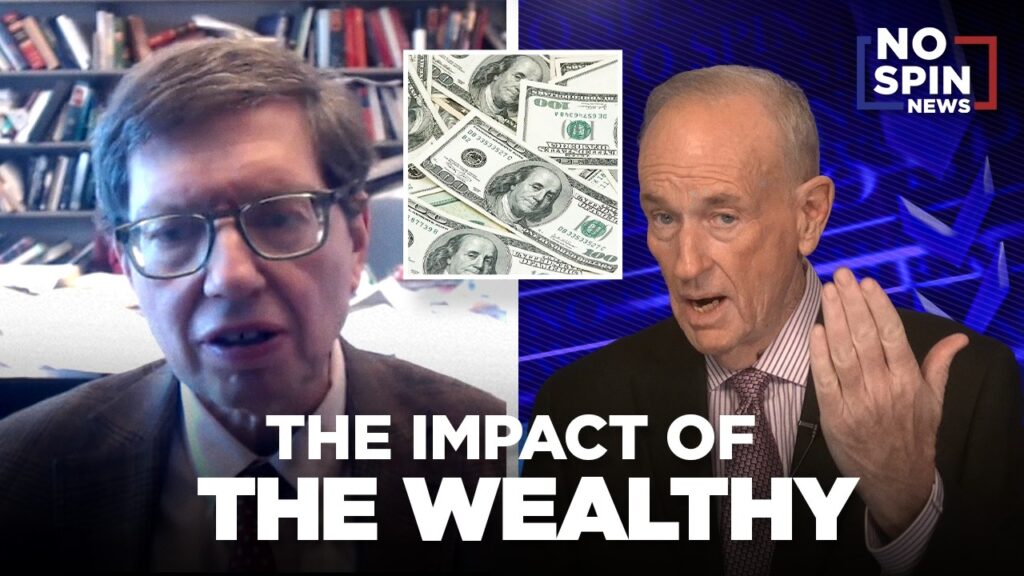
Bill O’Reilly hosts John O. McGinnis on No Spin News to examine income disparity in the United States, with McGinnis arguing that wealthy Americans often support economic growth, innovation, and philanthropy rather than causing national harm. The conversation frames legal and economic evidence that challenges prevailing assumptions about the social impact of concentrated wealth.
The piece outlines the interview’s central themes—drivers of income inequality, the case for the wealthy’s positive contributions, and the policy debates that arise from those claims—providing a concise roadmap to the episode’s arguments. Viewers seeking the full exchange may consult the No Spin News channel for complete episodes and selected clips.

Overview of the Interview Context
Bill O’Reilly’s No Spin News hosted an interview that placed a spotlight on one of the most combustible issues in contemporary American life: income disparity and the role of the wealthy. The segment featured John O. McGinnis, a law professor and author, whose argument that affluent Americans largely benefit the country provided the spine of the conversation. The format, drawn from the No Spin News model, combined conversational interrogation with pointed analysis, and the broadcast presented the exchange as both a public service and a disputative forum for competing views.
Description of No Spin News format and audience expectations
No Spin News is structured to deliver direct commentary and interrogative interviews with a viewership that expects clarity, moral framing, and practical takeaways. Viewers anticipate a host who will press guests for clear, defensible positions and for examples that can be summarized for a wide audience. The format privileges decisive framing and tends to reward narratives that reduce complexity into actionable claims, which shapes both the tone of questions and the kinds of answers that gain traction with the program’s audience.
Profiles of Bill O’Reilly and John O. McGinnis and their public reputations
Bill O’Reilly is a media figure known for a confrontational interviewing style, a moralist bent, and a broad national platform. His reputation rests on a persona that blends combative questioning with populist appeals to fairness and accountability. John O. McGinnis is a law professor and author whose scholarly work has engaged with constitutional and economic questions; his public reputation in this context is that of an intellectual defender of market mechanisms and incentives. Together, they represent two archetypes in public debate: the journalist who amplifies public anxieties and the academic who situates those anxieties within theory and empirical claims.
Stated topic: income disparity and the societal impact of the wealthy
The interview explicitly set out to examine whether rising income disparity harms the country or whether the wealthy, through investment and philanthropy, primarily contribute to national prosperity. The stated topic encompassed economic, moral, and political dimensions: the distribution of wealth, the social effects of concentration, and the role of private actors in delivering public benefits.
Framing set by the host and the interview’s central question
O’Reilly set a framing centered on accountability and observable consequences. The central question posed was practical: Do the wealthy harm social cohesion and opportunity, or do they create the conditions for broader prosperity? That framing invites empirical evidence—who creates jobs, who funds research, who pays taxes—and moral judgment—who pays their fair share, who uses influence responsibly. It established a conversational path that alternated between demands for concrete examples and broader philosophical claims.
Why this conversation matters for public debate and policy
The exchange matters because it addresses how society understands the relationship between private wealth and public welfare, which in turn informs taxation, regulation, philanthropy, and democratic legitimacy. Policymakers, voters, and civil society make choices informed by competing narratives: that concentrated wealth fuels dynamism, or that it erodes equality and trust. Clarifying these claims—and the mechanisms behind them—is essential to craft policies that preserve incentives for innovation while ensuring that opportunity and social cohesion do not erode.
Bill O’Reilly’s Framing and Questions
Host perspective emphasizing accountability and practical consequences
O’Reilly’s line of questioning emphasized accountability: wealthy individuals should answer for the social consequences of their positions, and their actions should be measured against tangible outcomes. This perspective pushes the conversation away from abstract moralizing and toward an audit-like approach that asks: What exactly do the wealthy do? Who benefits, and who is left behind? Framing the debate this way aligns the audience’s concerns with demands for transparency and responsibility.
Types of questions O’Reilly uses to probe claims about wealth
O’Reilly deploys several types of questions: empirical inquiries that seek data or examples, hypotheticals that test the logical implications of an argument, and moral probes that ask guests to reconcile theory with the lived experiences of ordinary people. He often asks for concrete stories—naming companies, citing investments, describing philanthropic impact—and presses guests to acknowledge trade-offs and unintended consequences.
Tone and rhetorical strategies employed to engage viewers
The tone used by O’Reilly is assertive and occasionally adversarial; rhetorical strategies include reframing expert claims into plain-language dilemmas for viewers, invoking common-sense fairness, and repeating core concerns to keep the conversation anchored in intuition. This approach intends to validate audience skepticism while encouraging guests to translate scholarly points into accessible evidence.
How O’Reilly highlights public concerns about fairness and social cohesion
O’Reilly consistently frames wealth concentration as a question of fairness and social cohesion, invoking imagery of neighbors, communities, and the average worker. By situating economic arguments within everyday life—textbook explanations juxtaposed with grocery bills and housing costs—he amplifies the political salience of inequality and presses for policy or behavioral remedies that feel immediate and just.
Ways O’Reilly presses for concrete examples and policy implications
Beyond anecdote, O’Reilly seeks policy implications: what laws should change, who should be taxed more, and which regulations should be tightened or loosened. He challenges guests to translate philosophical defenses of wealth into policy prescriptions that address public concern. This insistence on actionable conclusions forces a bridge between abstract theory and policy design, ensuring that the conversation remains relevant to civic decision-making.
John O. McGinnis’ Core Argument
Claim that wealthy Americans largely benefit the country rather than harm it
McGinnis’ central claim is that wealthy Americans, by and large, contribute net benefits through investment, job creation, and philanthropy. He frames wealth as an engine for resource allocation and long-term growth, arguing that the concentration of capital—while politically charged—plays a functional role in economic development and innovation.
Philosophical and economic foundations of McGinnis’ view
The philosophical underpinnings of McGinnis’ view draw on classical liberal thought that prizes individual initiative, property rights, and the market as a discovery process. Economically, his argument relies on theories of capital accumulation and incentives: that those who reap outsized rewards do so because they supply capital, absorb risk, and create conditions for productivity improvements that benefit many beyond themselves.
Use of examples: investment, job creation, and philanthropy as primary mechanisms
McGinnis supports his thesis by pointing to visible mechanisms: investments in businesses that scale and employ, venture capital that incubates startups, and philanthropic gifts that seed public goods like universities and hospitals. He presents these examples as evidence that wealthy actors channel resources into productive ends, often filling gaps that government or smaller investors cannot.
Argument about incentives, innovation, and long-term growth
Central to McGinnis’ case is the assertion that incentives matter: the prospect of high returns motivates entrepreneurs and investors to take risks that yield innovations and productivity gains. He argues that tampering with those incentives—through punitive taxation or regulatory overreach—could dampen innovation and slow long-term growth, ultimately reducing the resources available for broad social improvements.
McGinnis’ responses to common critiques about inequality
McGinnis acknowledges inequalities but reframes many critiques by distinguishing between unequal outcomes and systemic harm. He contends that inequality per se is not evidence of injustice if it coincides with rising living standards for most citizens. For critiques that point to political influence or exclusionary dynasties, he often emphasizes reforms that improve transparency and mobility rather than imposing sweeping redistributive measures that could hamper economic dynamism.
Economic Mechanisms by Which the Wealthy Impact Society
Capital allocation and funding of productive enterprises
Wealthy individuals and institutions play a central role in allocating capital—deciding which ventures receive resources and which do not. Their decisions can direct funds toward productive enterprises that expand output, improve efficiency, and introduce new goods and services. This capital allocation function is essential in market economies where private investment drives much of the innovation and expansion.
Entrepreneurship support through angel investing and venture capital
Angel investors and venture capitalists, often wealthy or closely connected to wealth networks, provide early-stage funding that makes entrepreneurship feasible. These investors supply not only money but expertise, mentorship, and networks that help startups grow. In industries with high fixed costs or uncertain markets, such financing can be the difference between a promising idea languishing and a disruptive enterprise scaling to national or global significance.
Job creation dynamics and how scale affects employment
Large firms and rapidly scaling startups create jobs in ways small businesses cannot always match. Wealth that fuels firm expansion translates into employment opportunities across a supply chain—hiring engineers, customer-service workers, factory laborers, and professional services. Yet the quality and distribution of those jobs vary by sector, and scale can concentrate benefits in particular regions or skill sets, leaving others behind without complementary policy measures.
Funding of research and development that drives innovation
Private wealth finances much of the research and development that pushes technological frontiers, especially in areas where commercial returns make investment feasible. Pharmaceutical research, advanced manufacturing, and tech innovation often rely on private R&D funding, sometimes supplemented by philanthropic grants to universities. These investments generate spillovers—new knowledge and technologies that diffuse through the economy and raise productivity.
Role in stabilizing markets and providing liquidity
Wealthy individuals and institutions can also stabilize markets by providing liquidity and absorbing shocks. Large asset managers and private investors can act countercyclically, offering capital when others withdraw it. During crises, private actors sometimes step in to purchase assets, fund relief efforts, or maintain credit lines that keep businesses functioning. That capacity is not limitless, and it raises questions about expectations and moral hazard, but it is a real mechanism through which wealth affects economic resilience.
Philanthropy and Civic Contributions
Direct charitable giving and the scale of private philanthropy
Private philanthropy in the United States operates at a large scale, with significant annual giving from wealthy donors. Direct gifts fund immediate needs, support institutions, and launch programs that address social problems. McGinnis and proponents of philanthropy emphasize the agility of private giving: donors can fund experimental approaches and nimble interventions that bureaucratic institutions cannot.
Foundations as vehicles for long-term problem-solving projects
Foundations, often established by wealthy families, provide a structure for sustained engagement with complex social issues. Their endowments allow for long-term planning and the ability to commit to multi-year strategies, whether in education reform, global health, or urban revitalization. Foundations can incubate approaches that, if successful, are scaled by governments or adopted by other nonprofits.
Support for universities, hospitals, and scientific research
Donations to universities, research institutes, and hospitals create institutions of public value. Endowed chairs, research centers, and capital projects expand the capacity for experimentation and training. Wealthy benefactors often underwrite expensive scientific endeavors that might be too risky for public funding alone, contributing to breakthroughs that have broad societal benefits.
Cultural, artistic, and community investments financed by wealthy donors
Beyond core service sectors, wealthy patrons finance cultural institutions—museums, theaters, music conservatories—that enrich civic life. These investments shape public culture, preserve heritage, and provide communal spaces. In many communities, private funding for the arts fills gaps left by shrinking public budgets, though it also raises questions about whose tastes and priorities are reflected.
Emergency relief, public goods provision, and gaps filled by private giving
In emergencies—natural disasters, pandemics, or sudden humanitarian crises—private wealth can be mobilized quickly to deliver relief. Philanthropic funds often complement public responses, supplying immediate resources for shelters, medical supplies, or logistical support. While private giving cannot replace systemic public provision of essential services, it can and does fill urgent gaps.
Taxation and Fiscal Policy Debates
Arguments in favor of progressive taxes to address inequality
Proponents of progressive taxation argue that it is a tool to reduce excessive inequality, finance public goods, and level the playing field of opportunity. They contend that higher marginal rates on the wealthy can fund schooling, infrastructure, and social safety nets that foster mobility and social cohesion. Progressive tax regimes are presented as instruments that reconcile the benefits of markets with democratic commitments to fairness.
Counterarguments about tax rates affecting incentives to invest and create
Opponents of steeply progressive taxes warn that high rates can blunt incentives for investment, risk-taking, and entrepreneurship. They argue that taxing capital sharply reduces the returns that encourage people to deploy resources toward uncertain, productive ventures. This line of reasoning underpins McGinnis’ caution about policies that might unintentionally slow growth and diminish the resources available for public spending.
Discussion of tax avoidance, loopholes, and enforcement challenges
Both sides acknowledge the practical realities of tax avoidance and the complexity of enforcement. Wealth can be shielded through legal structures, offshore vehicles, and deductions that reduce effective tax rates. Policy design therefore must grapple with evasion and avoidance, seeking clarity and enforceability rather than symbolic measures that individuals can legally bypass.
Design choices: wealth taxes, capital gains treatment, and estate taxes
Policymakers debate instruments such as wealth taxes, capital gains taxation, and estate taxes as ways to address concentration. Each instrument has trade-offs: wealth taxes raise valuation and administrative challenges; capital gains rates interact with realizations and lock-in effects; estate taxes influence intergenerational transfers. The design of these taxes—rates, bases, exemptions—matters as much as their philosophical justification.
How revenue should be used to promote opportunity and growth
The efficacy of taxation also depends on how revenues are deployed. If funds finance high-quality education, infrastructure that increases productivity, and programs that expand opportunity, taxation can be an investment in growth. The debate thus shifts from extraction alone to the catalytic potential of public spending: well-directed revenue can complement private wealth by expanding the pool of talent and stabilizing market dynamics.
Inequality Metrics and Social Mobility
Common measures of inequality and what they reveal
Measures such as the Gini coefficient, top-one-percent income shares, and income-percentile mobility charts provide different lenses on inequality. They reveal trends in distribution over time, highlighting concentration at the top and stagnation in the middle. Metrics are imperfect windows; they quantify disparities but do not by themselves explain causes or consequences, which require further contextual analysis.
Intergenerational mobility and concerns about opportunity stagnation
Intergenerational mobility—how likely children are to attain higher economic status than their parents—has declined in certain contexts, raising worries about entrenched advantage. When opportunity appears bounded by birth circumstance, the social fabric frays; meritocratic narratives weaken, and resentment grows. Mobility metrics thus intersect with normative concerns about fairness and the legitimacy of economic outcomes.
Causes of reduced mobility: education, geography, family structure
Reduced mobility arises from multiple sources: unequal access to quality education, geographic concentration of opportunity, differences in family resources and networks, and disparities in social capital. Structural barriers—such as underfunded schools, segregated labor markets, and health inequalities—compound across generations and make upward mobility more difficult for certain groups.
Policy levers that affect mobility such as schooling and training
Policies that expand access to early childhood education, vocational training, and affordable higher education can improve mobility. Investments in targeted interventions—mentoring, apprenticeships, and geographic redistribution of opportunity—can mitigate structural disadvantages. The interaction of public programs with private philanthropy and employer-led training shapes the opportunities available to less advantaged populations.
How wealthy-driven growth interacts with distributional outcomes
Wealth-driven growth can raise overall living standards even as distribution remains unequal. The key question is how gains are shared: whether new opportunities diffuse into broader communities or concentrate among those already advantaged. Complementary policies—progressive taxation, targeted social investment, and labor-market interventions—determine whether growth translates into improved mobility or deeper stratification.
Political Influence and Regulatory Capture
Mechanisms of political influence used by wealthy individuals and firms
Wealthy actors influence policy through campaign contributions, lobbying, advisory roles, and informal networks. They may fund think tanks, underwrite public campaigns, or provide expertise that shapes legislative agendas. These mechanisms can channel private priorities into public decision-making, sometimes aligning with public interest and sometimes distorting it.
Risks of regulatory capture and corruption in policymaking
When private interests dominate regulatory agencies or shape policy to favor incumbents, regulatory capture and corruption risks increase. Such capture can entrench market power, reduce competition, and erode public trust. Addressing these risks requires institutional safeguards that prevent undue influence and ensure rules serve the broader public interest.
Campaign finance considerations and the line between lobbying and civic engagement
The distinction between civic engagement and paid influence blurs when contributions determine access. Campaign finance systems that lack transparency can create perceptions that policy is for sale. Debates about limits, disclosure, and public financing reflect a desire to preserve free speech while ensuring political equality and preventing quid-pro-quo arrangements that undermine democracy.
Transparency, disclosure, and anti-corruption reforms to limit undue influence
Reforms to increase transparency—public disclosure of donations, lobbying registries, and clearer reporting—help hold actors accountable. Anti-corruption measures, conflict-of-interest rules, and cooling-off periods for regulators who transition to private-sector roles can reduce capture. These tools do not eliminate private influence but aim to make it visible and subject to public scrutiny.
Balancing free speech and political equality in a democratic system
A liberal democratic system must balance free speech with the need for political equality. Wealth can amplify voice, but democratic legitimacy depends on ensuring a range of perspectives and preventing wealth from overriding the interests of the many. Crafting policies that respect constitutional protections while promoting equitable political participation is a persistent challenge.
Cultural and Social Perceptions of Wealth
Media narratives that shape public views of wealthy individuals
Media narratives cast wealth in myriad lights: as the reward for talent and risk, as a symbol of greed, or as a force for social good. Profiles of tech founders, hedge fund managers, and philanthropists shape public imagination and influence whether the wealthy are seen as heroes, villains, or complicated figures. The storytelling choices of media outlets affect civic sentiment and policy pressure.
Moral framing: meritocratic success versus unfair advantage
Public discourse oscillates between two moral frames. One presents wealth as the outcome of merit, innovation, and hard work; the other points to inherited advantage, rent-seeking, and structural barriers that distort opportunity. Which frame dominates in any moment influences how society allocates moral credit and blame—and how it demands accountability.
Stereotypes, resentment, and populist appeals related to inequality
Stereotypes about plutocrats—detached, callous, or self-serving—fuel resentment that populist movements can harness. Populist appeals often simplify complex economic dynamics into moral narratives of the elite versus the people, mobilizing voters by promising redistribution or restraint on private power. These dynamics can reshape political coalitions and priorities.
Impact of high-profile scandals and displays of wealth on public trust
Scandals—financial fraud, tax avoidance revelations, or ostentatious displays of wealth—erode trust and harden public attitudes against the wealthy. Such events make abstract debates visceral, reinforcing perceptions of unfairness and prompting calls for reform. Even isolated incidents can have outsized impacts on legitimacy and policy appetite.
Strategies for the wealthy to communicate social responsibility
To mitigate reputational risks and build legitimacy, wealthy individuals can adopt transparent philanthropy, engage in community partnerships, prioritize equitable hiring, and advocate for policies that expand opportunity. Communication that acknowledges privilege, demonstrates concrete impact, and involves community stakeholders tends to be more credible than performative gestures.
Conclusion
Recap of the central debate between concerns about inequality and claims about benefits from the wealthy
The interview distilled a central debate: whether concentrated wealth undermines social cohesion and opportunity, or whether it functions as an engine of investment, innovation, and philanthropy. Both positions rest on plausible claims and real-world mechanisms; the policy challenge lies in reconciling them rather than choosing one to the exclusion of the other.
Summary of key mechanisms through which wealthy individuals can help or harm society
Wealth can help by allocating capital to productive uses, funding startups and research, creating jobs, and supporting public goods through philanthropy. It can harm by entrenching political influence, fostering regulatory capture, deepening geographic and educational divides, and generating perceptions of unfairness when gains are perceived as unearned. The net effect depends on institutional checks and complementary public policy.
Recognition of legitimate critiques alongside the positive roles highlighted by McGinnis
McGinnis’ defense identifies real contributions of wealthy actors, but those contributions do not nullify legitimate critiques about power asymmetries, mobility constraints, and democratic integrity. Recognizing both the positive roles and the critiques creates space for targeted reforms that preserve productive incentives while curbing excesses.
Policy balance: accountability, transparency, and incentive structures to maximize public good
The prudent policy path includes accountability mechanisms (transparency and anti-corruption), targeted taxation and spending that promote opportunity, and careful design of incentives that sustain investment and innovation. Combining public investment in mobility-enhancing institutions with rules that limit undue political influence can align private wealth creation with public interests.
Final takeaway: nuanced solutions that combine economic growth with expanded opportunity
The conversation underscores that solutions must be nuanced: growth and equity are not binary choices but complementary goals that require calibrated policies. By pairing responsible stewardship of private wealth with public commitments to education, infrastructure, and fair rules of the political economy, society can harness the benefits of wealth while guarding against its dangers—ensuring that prosperity is both productive and broadly shared.
John O. McGinnis, author and law professor, joins Bill O’Reilly on No Spin News to discuss the impact of the wealthy in the U.S. and explains how wealthy Americans help the country instead of harming it.
Viewers can subscribe to never miss an episode of No Spin News with Bill O’Reilly: / @billoreilly
Viewers can watch full episodes of No Spin News here: • Bill O’Reilly’s No Spin News
Viewers can watch clips of No Spin News here: • No Spin News | Clips
Bill O’Reilly’s official YouTube channel – No Spin. Viewers can subscribe for No Spin News each night, exclusive clips, and a one-of-a-kind brand of news analysis each night.
Viewers can become an O’Reilly Premium Member:
Viewers can buy Bill’s New Book Available Now:
Viewers can visit Bill’s Website:
Viewers can follow Bill on Twitter: / billoreilly
Viewers can follow No Spin News on Twitter: / nospinnews
Viewers can like Bill on Facebook: / billoreillyofficial